


 j
jGet Started with Communications, Media, and Energy (CME) Common APIs
Documentation Changelog
Introduction
FAQ
Troubleshooting
Diagnostic Tool for Standard Cart APIs
Standard cart REST APIs are the next-generation version of the cart-based APIs available in Summer’23. The standard cart APIs and their remote methods provide a layer of abstraction between client application development and the configuration of the underlying CPQ cart-based operation logic. Users can access and manipulate the quote, order, and cart data in the industries Configure, Price, Quote (CPQ).
Following are some of the features of standard cart APIs.
Classic Cart APIs run the CPQ engine in managed-package Apex. That path shares governor limits (CPU time, SOQL, and heap size) with other Apex work in the transaction.
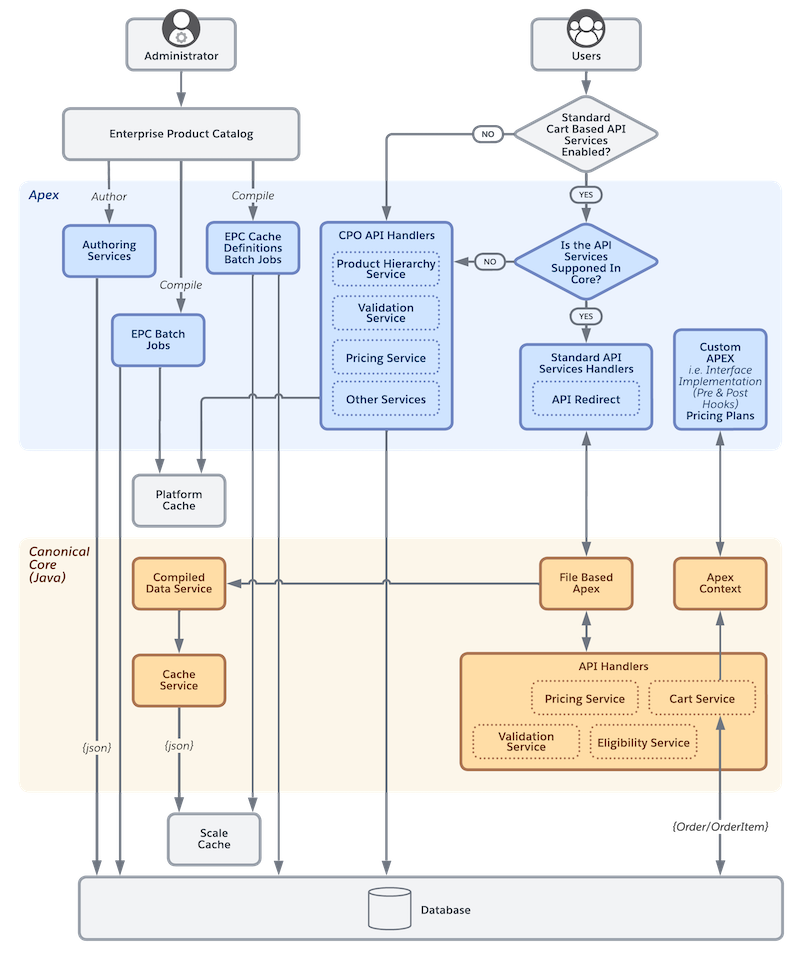
When you enable Standard Cart APIs, supported cart operations are routed to Salesforce core (Java) handlers for pricing, cart, and validation. Compiled catalog data is stored in Scale Cache and CachedAPIResponse__c. Cart APIs that are not yet on the Standard list continue to run on the Classic Apex path.
Custom implementations that run for both paths must switch dynamically: use CpqCartDocument for Standard Cart APIs, and line-item sObjects for Classic Cart APIs. See Use CpqCartDocument and Cart APIs vs Standard Cart APIs.
The following flow diagram provides high-level overview of CPQ data layer workflow.
Before you begin, Check Feature Compatibility for using the standard cart APIs. Review Known Limitations for behaviors that still differ from Classic Cart APIs.
j