Salesforce’s TMF API extensibility framework enables customers to modify standard TMF-compliant APIs to meet specific business requirements while maintaining interoperability and scalability.
Customers extend TMF schemas through the TMF extension model, and Salesforce provides a backend framework that supports custom mappings, validations, transformations, and lifecycle hooks.
This framework enables customers to implement custom logic and additional attributes across TMF operations while adhering to platform guidelines for scalability, data integrity, and compliance.
Key Features
Flexible Field and Entity Mapping
Remap TMF payload fields to different Salesforce fields or objects
Support both standard and custom entities
Extend responses by adding or reshaping fields
Attribute Extensibility
Allow customers to introduce additional TMF fields or sub-resources
Map newly added schema elements to Salesforce data structures
Advanced Query Extensibility
Support custom filtering, sorting, and pagination
Enable object-level query extensions
Custom Validations
Allow business-specific validation rules to be plugged into the request lifecycle
Support pre- and post-processing validation logic
Transformations and Execution Hooks
Provide lifecycle hooks for request/response transformation
Support overrides for core transformation, pre-processing, and post-processing logic
Inbound and Outbound API Extensibility
Apply custom logic to incoming API requests and outgoing API responses
Enable modifications for TMF (GET/POST/PATCH/DELETE) operations
Architecture
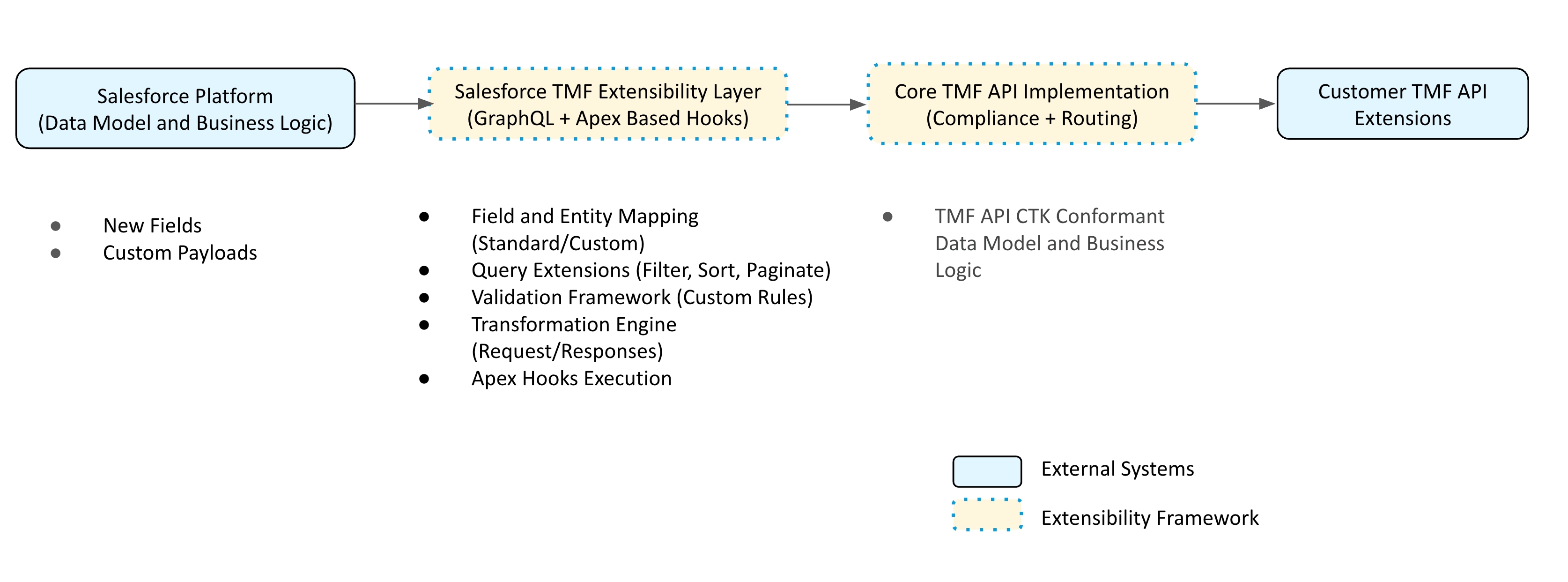
The following block diagram provides a high-level overview of how the various components are involved in handling extensibility for TMF APIs.


 j
j