


Salesforce1 Mobile App Developer Guide
 j
jAction Categories
Actions fall into several different categories. You may see some but not others, depending on the age and configuration of your organization.
- Standard actions
- Standard actions are actions that are included automatically when Chatter is enabled: Post, File, Link, Poll, and, in organizations that use work.com, Thanks. Standard actions can also include any you’ve created for your organization using point-and-click methods, such as create or Log A Call actions.
- Default actions
-
Default actions are predefined actions provided by Salesforce to get you and your users started
using actions in your organization. Add default actions to publisher layouts to make them
available to your users on the Home page, record detail pages, and the Chatter tab in the
full Salesforce site, as well as in the
action bar in Salesforce1.
In organizations that are created after Winter ‘14, Salesforce automatically adds default actions to the global publisher layout and to the publisher layout on account, case, contact, lead, and opportunity objects. In organizations that were created before Winter ‘14, default actions are available in the palette on the page layout editor, but they’re not automatically added to publisher layouts.
- Since our Development organization is new, it contains a set of default actions. You can check out the default global actions in Setup at .
- For a list of which default actions appear on which object, see “Default Actions” in the Salesforce Help.
- Mobile smart actions
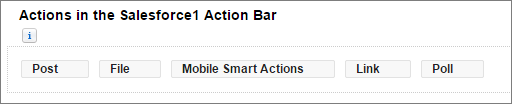
- Mobile smart actions are a set of preconfigured actions, just like default actions, and are supported on the same list of objects. However, they appear in pre-Winter ’14 organizations and are displayed only in Salesforce1.
-
In Salesforce1, the Mobile Smart Actions
element expands to a set of distinct create actions that enable users to create
records directly in the feed.
- Mobile smart actions are populated with all your organization’s required fields on the relevant object, regardless of how many fields there are. For example, the New Case action in the mobile smart action bundle includes all required case fields. You can’t edit the fields on mobile smart actions. The fields that appear change only if you change which fields on an object are required.
- Mobile smart actions don’t appear in the full Salesforce site, regardless of which page layouts you add them to; they appear only to users in Salesforce1.
- For more information on mobile smart actions, and a list of what the mobile smart action element on each supported object expands to include, see “Mobile Smart Actions ” in the Salesforce Help.
- Custom actions
-
Custom actions are Visualforce pages or canvas apps with
functionality that you define. For example, you can create a custom action so that
users can write comments that are longer than 5,000 characters, or create one that
integrates a video-conferencing application so that support agents can communicate
visually with customers.
We’ll touch briefly on custom actions later in About Custom Actions, but you can find out much more about them in the Adding Functionality with Visualforce Custom Actions chapter.
- Productivity Actions
- Productivity actions are predefined by Salesforce and are attached to a limited set of objects. You can’t edit or delete productivity actions.