


Salesforce Security Guide
 j
jNewer Version Available
Set Two-Factor Authentication Login Requirements and Custom Policies for Single Sign-On, Social Sign-On, and Communities
| Available in: both Salesforce Classic (not available in all orgs) and Lightning Experience |
| Available in: Enterprise, Performance, Unlimited, and Developer Editions |
| User Permissions Needed | |
|---|---|
| To edit profiles and permission sets: | Manage Profiles and Permission Sets |
| To generate a temporary verification code: | Manage Two-Factor Authentication in User Interface |
Watch a demo:  Lightning Login Overview
(English Only)
Lightning Login Overview
(English Only)
To require two-factor authentication for users assigned to a particular profile, edit the Session security level required at login profile setting. Then set your org’s session security levels to apply the policy for particular login methods.
By default, the Session security requirement at login profile setting is None. You can edit a profile’s session settings to change the requirement to High Assurance. When profile users with the High Assurance requirement use a login method that grants standard-level security instead of high assurance, they’re prompted to verify their identity with two-factor authentication. After users authenticate successfully, they’re logged in to Salesforce.
You can edit the security level, either standard or high assurance, assigned to a login method in your org’s session settings.
Users with mobile devices can use the Salesforce Authenticator mobile app or another authenticator app for two-factor authentication. Internal users can connect the app to their account in the Advanced User Details page of their personal settings. If you set the High Assurance requirement on a profile, profile users without the Salesforce Authenticator or another authenticator app are prompted to connect the app to their account. After they connect the app, they’re prompted to use the app to verify their identity.
Users can use registered U2F security keys for two-factor authentication.
- From Setup, enter Profiles in the Quick Find box, then select Profiles.
- Select a profile.
- Scroll to Session Settings and find the Session security level required at login setting.
- Click Edit, and select High Assurance.
- Click Save.
- From Setup, enter Session Settings in the Quick Find box, then select Session Settings.
-
In Session Security Levels, make sure that Two-Factor
Authentication is in the High Assurance column.
If Two-Factor Authentication is in the Standard column, users get an error when they log in with a method that grants standard-level security.
- Save your changes.
Example
- In the Customer Community User profile, set the session security level required at login to High Assurance.
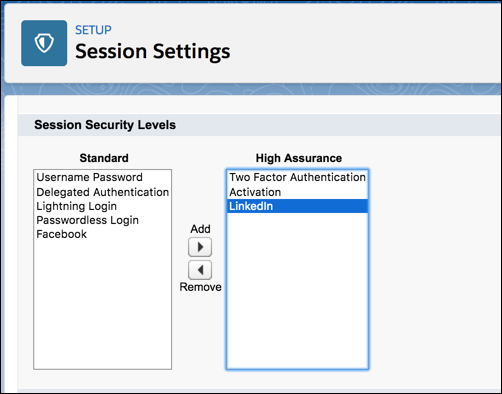
- In your org’s session settings, edit the session security levels.
- Because you are requiring two-factor authentication with Facebook accounts, make sure that Facebook is in the Standard column.
- Add Two-Factor Authentication to the High Assurance column. When users log in with their Facebook account, they are required to provide a second authentication factor.
- Add LinkedIn to the High Assurance column. When users log in with their LinkedIn account, they are granted High Assurance access without needing to provide a second authentication factor.
If users lose or forget the device they usually use for two-factor authentication, you can generate a temporary verification code for them. You set when the code expires, from 1 to 24 hours after you generate it. Your user can use the code multiple times until it expires. A user can have only one temporary code at a time. If a user needs a new code while the old code is still valid, you can expire the old code, then generate a new one. Users can expire their own valid codes in their personal settings.