


Salesforce Health Cloud Developer Guide
 j
jWinter '27 (API version 68.0)
Summer '26 (API version 67.0)
Spring '26 (API version 66.0)
Winter '26 (API version 65.0)
Summer '25 (API version 64.0)
Spring '25 (API version 63.0)
Winter '25 (API version 62.0)
Summer '24 (API version 61.0)
Spring '24 (API version 60.0)
Winter '24 (API version 59.0)
Summer '23 (API version 58.0)
Spring '23 (API version 57.0)
Winter '23 (API version 56.0)
Summer '22 (API version 55.0)
Spring '22 (API version 54.0)
Winter '22 (API version 53.0)
Summer '21 (API version 52.0)
Spring '21 (API version 51.0)
Winter '21 (API version 50.0)
Summer '20 (API version 49.0)
Spring '20 (API version 48.0)
Winter '20 (API version 47.0)
Summer '19 (API version 46.0)
Spring '19 (API version 45.0)
Winter '19 (API version 44.0)
Summer '18 (API version 43.0)
Spring '18 (API version 42.0)
Winter '18 (API version 41.0)
Summer '17 (API version 40.0)
Spring '17 (API version 39.0)
Winter '17 (API version 38.0)
Summer '16 (API version 37.0)
Provider Relationship Management Overview
Provider Relationship Management Object Permissions
Accreditation
ApplicationCase
Award
BoardCertification
BusinessLicense
CareProviderAdverseAction
CareProviderFacilitySpecialty
CareProviderSearchableField
CareProviderSearchConfig
CareSpecialty
CareSpecialtyTaxonomy
CareTaxonomy
HealthcareFacilityNetwork
HealthcarePayerNetwork
HealthcarePractitionerFacility
HealthcareProvider
HealthcareProviderNpi
HealthcareProviderSpecialty
HealthcareProviderTaxonomy
IndividualApplication
Insurance Policy
PersonEducation
Creating and Importing Documents
Newer Version Available
Provider Network Management
Provider Network Management allows health insurance companies to bring providers into
their network. The provider network management data model provides objects for managing provider
application and credentialing data, so you can easily enroll providers into your network and help
your members or patients find care that fits their needs.
| Available in: Enterprise and Unlimited Editions |
With the provider relationship data model, providers can apply to join a network and credentialing specialists can then validate information such as the education qualifications, certifications, and employment history to enroll providers into the network.
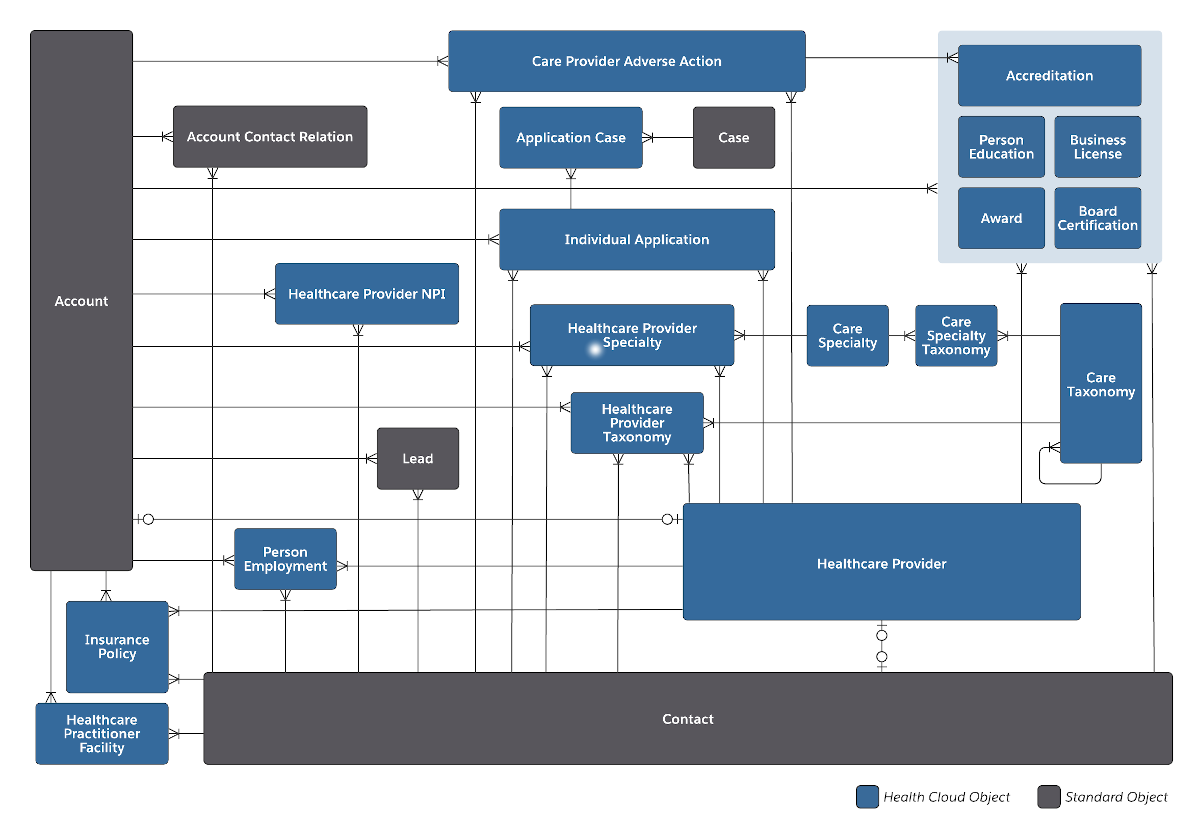
To use Health Cloud for provider network management, assign the Health Cloud permission set and the Provider Network Management permission set to your users.
The Provider Recruiting and Credentialing features of the Vlocity Health and Insurance package are fully supported in Health Cloud. You will need the Vlocity Health and Insurance package for OmniStudio.
Note
-
Provider Relationship Management Overview
Use the Health Cloud provider relationship management data model along with standard Salesforce objects to manage your network of providers. -
Provider Relationship Management Object Permissions
The provider network management standard objects are available to users with the Health Cloud and the Health Cloud Platform permission set licenses and the Health Foundation permission set. -
Vlocity Health and Insurance Objects Available in Health Cloud
The Provider Recruiting and Credentialing Application features of the Vlocity Health and Insurance package are fully supported in Health Cloud. Each Vlocity field has an equivalent Health Cloud field, which you can find here. -
Accreditation
Represents the professional accreditations of a facility. For example, a joint commission accredits a facility as a general acute care hospital. -
ApplicationCase
This junction object between Case and IndividualApplication. This object is available in API version 52.0 and later. -
Award
Represents a person's or organization's professional awards. -
BoardCertification
Represents the practitioner's board certifications such as being board-certified in cardiology and cardiovascular disease. -
BusinessLicense
Represents the licenses of a party role like healthcare provider or producer. -
CareProviderAdverseAction
This object captures adverse actions against the provider, such as malpractice lawsuits or revoked licences. This object is available in API version 47.0 and later. -
CareProviderFacilitySpecialty
Represents all the specialties that the practitioner provides at a given location. For example, a physician who is board-certified in both spine and neuro may provide spine services at one location and neuro services at another. -
CareProviderSearchableField
This object holds denormalized data from certain fields in the Provider data model. Provider search APIs query this object instead of multiple objects, which improves search performance. This object is available in API version 47.0 and later. -
CareProviderSearchConfig
Represents fields that can appear in provider search results. Use this object to specify fields in arbitrary objects (source) that are made available in the search object (target). This object is available in API version 48.0 and later. -
CareSpecialty
Represents a listing of provider specialty codes and descriptions. For example, 02 - Physician/General Surgery. -
CareSpecialtyTaxonomy
The junction object between CareSpecialty and CareTaxonomy. This object is available in API version 52.0 and later. -
CareTaxonomy
Represents a static list of taxonomy codes. -
HealthcareFacilityNetwork
Represents a junction object identifying the insurance network that a location or business entity is a part of. -
HealthcarePayerNetwork
Represents an insurance network group. For example, an insurance company’s exclusive provider organization (EPO) plans. -
HealthcarePractitionerFacility
Represents the different locations in which a practitioner provides services. -
HealthcareProvider
Represents business-level details about the healthcare organization or the practitioner. -
HealthcareProviderNpi
Represents identifiers from the National Provider Identifier that are assigned to every facility and licensed practitioner in the United States. Also includes NPI assigned date, primary mailing address on file, and so on. -
HealthcareProviderSpecialty
Represents specialties for a practitioner or a provider service organization. A provider can have multiple specialties such as anesthesiology and cardiovascular. -
HealthcareProviderTaxonomy
Represents taxonomy or subspecialty codes for a practitioner or facility. A provider or facility can have multiple taxonomies. -
IndividualApplication
Represents an application form submitted by an individual. -
Insurance Policy
Represents a type of insurance policy, such as auto, home, life, or annuity. -
PersonEducation
Represents information about professional education for a person in a provider role.