


REST API Developer Guide
 j
jNewer Version Available
Composite Subrequest Result
Properties
| Name | Type | Description |
|---|---|---|
| body | The type depends on the response type of the subrequest. |
The response body of this subrequest. See the documentation for the subrequest resource for more information. If the subrequest returns an error, the body includes the error code and message. For more details on error responses, see Status Codes and Error Responses. |
| httpHeaders | Map<String, String> | Response headers and their values for this subrequest. The Composite resource doesn’t support the Content-Length header, so subrequest responses don’t include this header and neither does the top-level response. |
| httpStatusCode | Integer | An HTTP status code for this subrequest. If allOrNone is set to true in the composite request and a subrequest returns an error, all other subrequests return the 400 HTTP status code. |
| referenceId | String | The reference ID specified in the subrequest. This property lets you easily associate subrequests with their results. |
Example
1{
2   "body": {
3      "id": "001R00000064wdtIAA",
4      "success": true,
5      "errors": []
6   },
7   "httpHeaders": {
8      "Location": "/services/data/v55.0/sobjects/Account/001R00000064wdtIAA"
9   },
10   "httpStatusCode": 201,
11   "referenceId": "refAccount"
12}
The following example shows the response for a subrequest that had an error while trying to create a Contact:
1{
2  "body" : [ {
3    "message" : "Email: invalid email address: Not a real email address",
4    "errorCode" : "INVALID_EMAIL_ADDRESS",
5    "fields" : [ "Email" ]
6  } ],
7  "httpHeaders" : { },
8  "httpStatusCode" : 400,
9  "referenceId" : "badContact"
10}
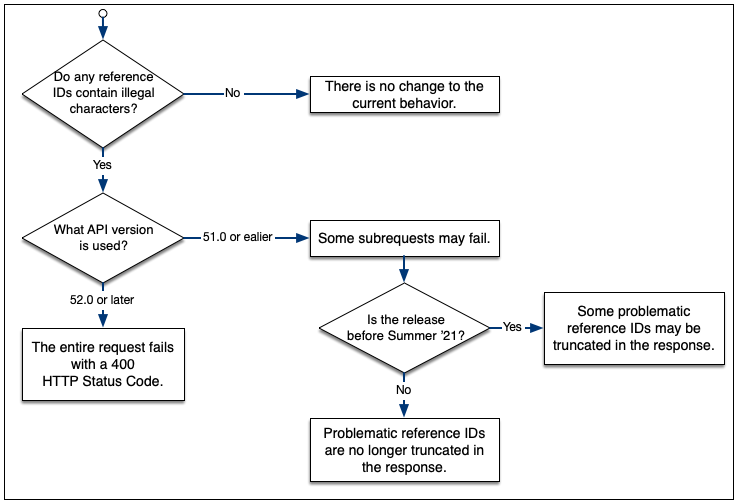
Behavior and Responses If There Are Illegal Characters in Reference IDs
The referenceIds must not contain anything besides letters, numbers, and underscores (’_’).
The API’s behavior if there are illegal characters depends on the API version and the release. (The pertinent API version is that used to make the composite request. That version isn’t necessarily the same as the API version specified in the url parameters in the subrequests.)
- Create an account named “Cloudy Consulting”.
- Create a Contact, “Mary Smith”, linked to the Cloudy Consulting account.
- Create another new account, named “Easy Spaces”.
1{
2  "allOrNone": false,
3  "compositeRequest": [
4    {
5      "method": "POST",
6      "body": {
7        "name": "Cloudy Consulting"
8      },
9      "url": "/services/data/vXX.X/sobjects/Account/",
10      "referenceId": "refNewAccount[1]"
11    },
12    {
13      "method": "POST",
14      "body": {
15        "AccountId": "@{refNewAccount[1].id}",
16        "FirstName": "Mary",
17        "LastName": "Smith”
18      },
19      "url": "/services/data/vXX.X/sobjects/Contact",
20      "referenceId": "refNewContact"
21    },
22    {
23      "method": "POST",
24      "body": {
25        "name": "Easy Spaces"
26      },
27      "url": "/services/data/vXX.X/sobjects/Account/",
28      "referenceId": "refNewAccount2"
29    }
30  ]
31}
Version 51.0 and Earlier
1HTTP/1.1 200 OK
2{
3   "compositeResponse" : [
4      {
5         "body" : {
6            "id" : "001R0000006hfeZIAQ",
7            "success" : true,
8            "errors" : [ ]
9         },
10         "httpHeaders" : {
11            "Location" : "/services/data/v51.0/sobjects/Account/001R0000006hfeZIAQ"
12         },
13         "httpStatusCode" : 201,
14         "referenceId" : "refNewAccount[1]"
15      },
16      {
17         "body" : [
18            {
19               "errorCode" : "PROCESSING_HALTED",
20               "message" : "Invalid reference specified. No value for refNewAccount[1].id found in refNewAccount.
21            }
22         ],
23         "httpHeaders" : { },
24         "httpStatusCode" : 400,
25         "referenceId" : "refNewContact"
26      },
27      {
28         "body" : {
29            "id" : "001R0000006hfeeIAA",
30            "success" : true,
31            "errors" : [ ]
32         },
33         "httpHeaders" : {
34            "Location" : "/services/data/v51.0/sobjects/Account/001R0000006hfeeIAA"
35         },
36         "httpStatusCode" : 201,
37         "referenceId" : "refNewAccount2"
38      }
39   ]
40}
The two accounts are created (even though the first account uses illegal characters in its reference ID). But the attempt to create a contact (using the reference ID containing illegal characters) fails.
Responses for Version 51.0 and Earlier in Previous Releases
The response shown above is that for the Summer ’21 release and later. In releases before Summer ’21, problematic reference IDs in the response were truncated if the IDs contained ‘(’ or ‘[’. So the response would have been:
1{
2   "compositeResponse" : [
3      {
4         "body" : {
5            "id" : "001R0000006hfeZIAQ",
6            "success" : true,
7            "errors" : [ ]
8         },
9         "httpHeaders" : {
10            "Location" : "/services/data/v51.0/sobjects/Account/001R0000006hfeZIAQ"
11         },
12         "httpStatusCode" : 201,
13         "referenceId" : "refNewAccount"
14      },
15     ...
16}
Starting with the Summer ’21 release, problematic reference IDs are no longer truncated. This change makes it easier to match the parts of the response to the request.
Version 52.0 and Later
1HTTP/1.1 400 Bad Request
2[
3   {
4      "message" : "Provided referenceId ('refNewAccount[1]') must start with a letter or a number, and it can contain only letters, numbers and underscores ('_').",
5      "errorCode" : "JSON_PARSER_ERROR"
6   }
7]
Summary
Behavior for References to Null Fields
The API’s behavior if there are references to null fields depends on the API version. (The pertinent API version is that used to make the composite request. That version isn’t necessarily the same as the API version specified in the url parameters in the subrequests.)
For example, consider this request. It locates an existing Contact and then uses @{refContact.FirstName} and @{refContact.LastName} to create a record.
1POST https://MyDomainName.my.salesforce.com/services/data/vXX.X/composite -H "Authorization: Bearer token"
2
3   "compositeRequest" : [
4      {
5         "method" : "GET",
6         "url" : "/services/data/v51.0/sobjects/Contact/003RO0000016kOuYAI?fields=FirstName,LastName",
7         "referenceId" : "refContact"
8      },
9      {
10         "method" : "POST",
11         "url" : "/services/data/v51.0/sobjects/Contact",
12         "referenceId" : "newContact",
13         "body" : {
14            "FirstName" : "@{refContact.FirstName}",
15            "LastName" : "@{refContact.LastName}",
16            "AccountId" : "001RO000001nGCdYAM"
17         }
18      }
19   ]
20}
What happens if the Contact’s first name is null (not set)?
Responses for Version 51.0 and Earlier
In API version 51.0 and earlier, the fact that the Contact’s FirstName field is null causes the dependent subrequest to fail.
1{
2   "compositeResponse" : [
3      {
4         "body" : {
5            "attributes" : {
6               "type" : "Contact",
7               "url" : "/services/data/v51.0/sobjects/Contact/003RO0000016kOuYAI"
8            },
9            "FirstName" : null,
10            "LastName" : "Wong",
11            "Id" : "003RO0000016kOuYAI"
12         },
13         "httpHeaders" : { },
14         "httpStatusCode" : 200,
15         "referenceId" : "refContact"
16      },
17      {
18         "body" : [
19            {
20               "errorCode" : "PROCESSING_HALTED",
21               "message" : "Invalid reference specified. No value for refContact.FirstName found in refContact.
22              Provided referenceId ('refContact.FirstName') must start with a letter or a number,
23              and it can contain only letters, numbers and underscores ('_')."
24            }
25         ],
26         "httpHeaders" : { },
27         "httpStatusCode" : 400,
28         "referenceId" : "newContact"
29      }
30   ]
31}
That example assumes that allOrNone is set to false. If it’s true, the whole composite request is rolled back. See allOrNone Parameters in Composite and Collections Requests.
Responses for Version 52.0 and Later
In API version 52.0 and later, the request succeeds.
1{
2   "compositeResponse" : [
3      {
4         "body" : {
5            "attributes" : {
6               "type" : "Contact",
7               "url" : "/services/data/v51.0/sobjects/Contact/003RO0000016kOuYAI"
8            },
9            "FirstName" : null,
10            "LastName" : "Wong",
11            "Id" : "003RO0000016kOuYAI"
12         },
13         "httpHeaders" : { },
14         "httpStatusCode" : 200,
15         "referenceId" : "refContact"
16      },
17      {
18         "body" : {
19            "id" : "003RO0000016kRAYAY",
20            "success" : true,
21            "errors" : [ ]
22         },
23         "httpHeaders" : {
24            "Location" : "/services/data/v51.0/sobjects/Contact/003RO0000016kRAYAY"
25         },
26         "httpStatusCode" : 201,
27         "referenceId" : "newContact"
28      }
29   ]
30}
Behavior for References to Fields That Aren’t Specified in the Parent Request
In dependent subrequests, you must always only use fields that are explicitly selected in parent requests. If this practice isn’t followed, the API’s behavior depends on the API version. (The pertinent API version is that used to make the composite request. That version isn’t necessarily the same as the API version specified in the url parameters in the subrequests.)
For example, consider the following request. It attempts to:
- Locate a specific Contact.
- Use @{refContact.records[0].AccountId} to get that Contact’s Account ID.
However, the parent request doesn’t explicitly query for the AccountId.
1POST https://MyDomainName.my.salesforce.com/services/data/vXX.X/composite -H "Authorization: Bearer token"
2
3{
4   "compositeRequest" : [
5      {
6         "method" : "GET",
7         "url" : "/services/data/v51.0/query?q=select Id, Account.Name from Contact where Id='003RO0000016kOuYAI'",
8         "referenceId" : "refContact"
9      },
10      {
11         "method" : "GET",
12         "url" : "/services/data/v50.0/query?q=select Name from Account where Id = '@{refContact.records[0].AccountId}'",
13         "referenceId" : "refAccount"
14      }
15   ]
16}
Responses for Version 51.0 and Earlier
In API version 51.0 and earlier, there are rare cases where such a request succeeds.
Responses for Version 52.0 and Later
In API version 52.0 and later, the request always fails:
1{
2   "compositeResponse" : [
3      {
4         "body" : {
5            "totalSize" : 1,
6            "done" : true,
7            "records" : [
8               {
9                  "attributes" : {
10                     "type" : "Contact",
11                     "url" : "/services/data/v51.0/sobjects/Contact/003RO0000016kOuYAI"
12                  },
13                  "Id" : "003RO0000016kOuYAI",
14                  "Account" : {
15                     "attributes" : {
16                        "type" : "Account",
17                        "url" : "/services/data/v51.0/sobjects/Account/001RO000001nGbUYAU"
18                     },
19                     "Name" : "City Medical Center"
20                  }
21               }
22            ]
23         },
24         "httpHeaders" : { },
25         "httpStatusCode" : 200,
26         "referenceId" : "refContact"
27      },
28      {
29         "body" : [
30            {
31               "errorCode" : "PROCESSING_HALTED",
32               "message" : "Invalid reference specified. No value for refContact.records[0].AccountId found in refContact.
33               Provided referenceId ('refContact.records[0].AccountId') must start with a letter or a number, and it can contain
34               only letters, numbers and underscores ('_')."
35            }
36         ],
37         "httpHeaders" : { },
38         "httpStatusCode" : 400,
39         "referenceId" : "refAccount"
40      }
41   ]
42}1{
2 "compositeRequest" : [
3 {
4 "method" : "GET",
5 "url" : "/services/data/v51.0/query?q=select Id, Account.Name, AccountId from Contact where Id='003RO0000016kOuYAI'",
6 "referenceId" : "refContact"
7 },
8 {
9 "method" : "GET",
10 "url" : "/services/data/v50.0/query?q=select Name from Account where Id = '@{refContact.records[0].AccountId}'",
11 "referenceId" : "refAccount"
12 }
13 ]
14}