


Salesforce Health Cloud Developer Guide
 j
jWinter '27 (API version 68.0)
Summer '26 (API version 67.0)
Spring '26 (API version 66.0)
Winter '26 (API version 65.0)
Summer '25 (API version 64.0)
Spring '25 (API version 63.0)
Winter '25 (API version 62.0)
Summer '24 (API version 61.0)
Spring '24 (API version 60.0)
Winter '24 (API version 59.0)
Summer '23 (API version 58.0)
Spring '23 (API version 57.0)
Winter '23 (API version 56.0)
Summer '22 (API version 55.0)
Spring '22 (API version 54.0)
Winter '22 (API version 53.0)
Summer '21 (API version 52.0)
Spring '21 (API version 51.0)
Winter '21 (API version 50.0)
Summer '20 (API version 49.0)
Spring '20 (API version 48.0)
Winter '20 (API version 47.0)
Summer '19 (API version 46.0)
Spring '19 (API version 45.0)
Winter '19 (API version 44.0)
Summer '18 (API version 43.0)
Spring '18 (API version 42.0)
Winter '18 (API version 41.0)
Summer '17 (API version 40.0)
Spring '17 (API version 39.0)
Winter '17 (API version 38.0)
Summer '16 (API version 37.0)
Adverse Events
Practitioner Availability at Facilities
AppointmentReason
ApptReasonEngmtChannelType
AssetType
CarePractnFacilityAppt
ClinicalEncounter
ServiceAppointmentAsset
WorkTypeAssetType
WorkTypeCareSpecialty
WorkTypeCodeSetBundle
Participant Management
API End-of-Life Policy
Newer Version Available
Intelligent Appointment Management
Health Cloud integrates with a customer’s appointment management system to provide a
patient appointment booking experience in Salesforce for call center agents and care coordinators.
The Health Cloud data model for appointments enables you to work with multiple source systems
operating on different electronic health record platforms.
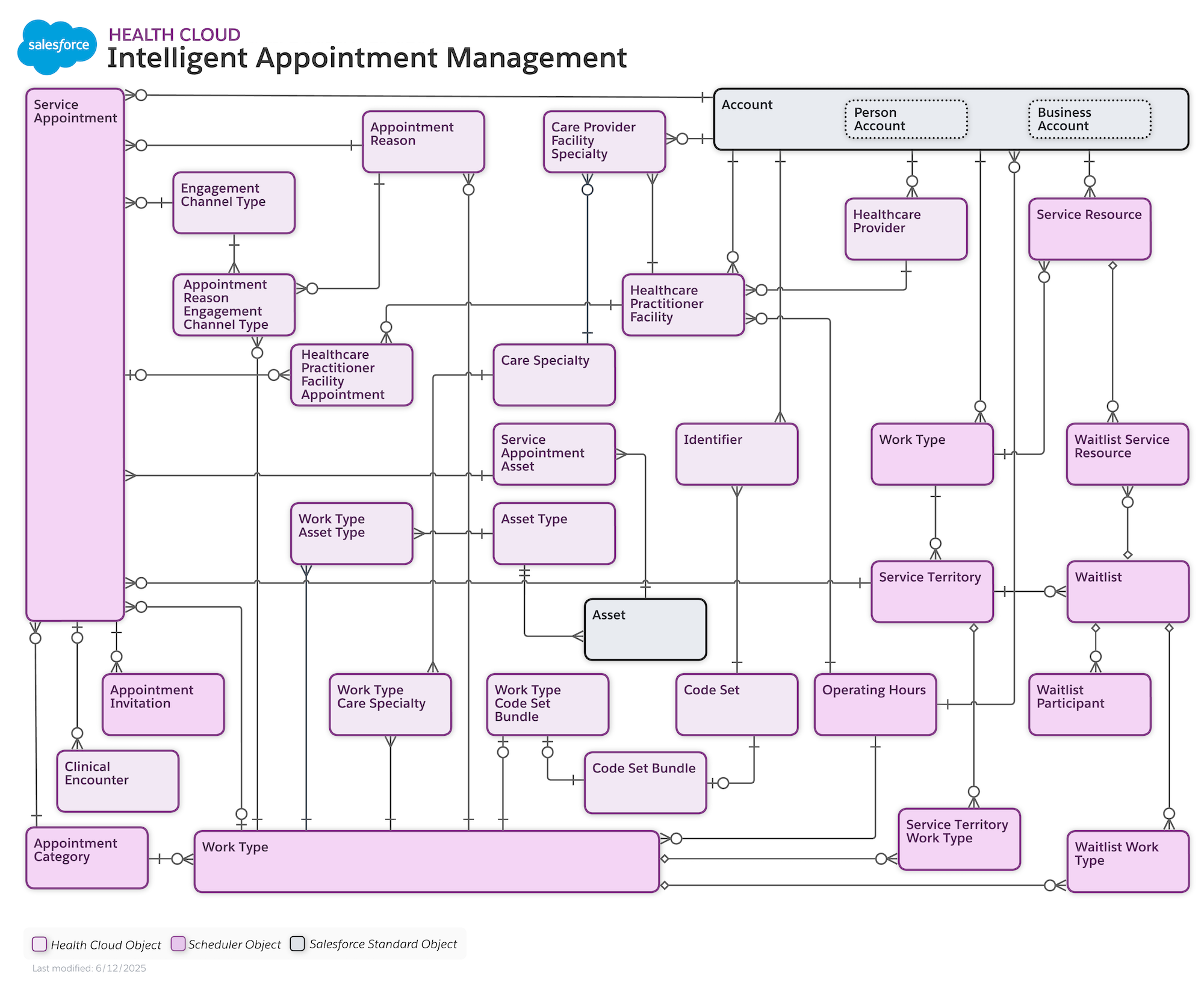
For more details and a larger image, visit the Data Model Gallery.
-
Practitioner Availability at Facilities
To book an appointment, we need to know the availability of a given practitioner at a given facility. To get this information, Health Cloud queries the specific source EHR system, using the IDs of the practitioner and the facility as stored in that source system. -
AppointmentReason
Represents a patient’s reason for making an appointment. Used for self-scheduling in Intelligent Appointment Management. This object is available in API version 53.0 and later. -
ApptReasonEngmtChannelType
Represents an available engagement channel for a given AppointmentReason. Possible engagement channels could be video, phone, or in person. Possible appointment reasons could be annual physical, fever, or physical therapy. This object is available in API version 56.0 and later. -
AssetType
Represents a type of asset, such as a type of item, physical space, or service offering. This object is available in API version 62.0 and later. -
CarePractnFacilityAppt
Represents a junction object between a HealthcarePractitionerFacility (practitioner at a facility) and a ServiceAppointment (appointment). This object is available in API version 52.0 and later. -
ClinicalEncounter
Represents a healthcare related encounter of a patient with a care provider. This is a broad object that covers multiple phases of a patient’s healthcare service experience, all the way from pre-admission to stay to discharge, and everything in between. This object is available in API version 51.0 and later. -
ServiceAppointmentAsset
Represents a junction between Service Appointment and Asset. This junction object enables admins to associate a patient appointment to an asset such as a piece of medical equipment. This object is available in API version 62.0 and later. -
WorkTypeAssetType
Represents a junction between Work Type and Asset Type. This junction object enables admins to associate a visit type such as PRP Hair Restoration to an asset type such as Room. This object is available in API version 62.0 and later. -
WorkTypeCareSpecialty
Represents a relationship between a care specialty and a visit type (Work Type). This object is available in API version 52.0 and later. -
WorkTypeCodeSetBundle
Represents a relationship between visit type (Work Type) and code set bundles that represent the service and appointment details for the visit type. This object is available in API version 52.0 and later.