Providing Chart Data via a Controller Method
The most straightforward way to provide data to a chart is using a Visualforce expression that references a controller method. Simply reference the controller in the <apex:chart> data attribute.
On the server side, write a controller method that returns a List of objects, which can be your own Apex wrapper objects as in A Simple Charting Example, sObjects, or AggregateResult objects. The method is evaluated server-side, and the results serialized to JSON. On the client, these results are used directly by <apex:chart>, with no further opportunity for processing.
To illustrate this technique with sObjects, here is a simple controller that returns a list of Opportunities, and a bar chart for their amounts:
1public class OppsController {
2
3    // Get a set of Opportunities
4    public ApexPages.StandardSetController setCon {
5        get {
6            if(setCon == null) {
7                setCon = new ApexPages.StandardSetController(Database.getQueryLocator(
8                      [SELECT name, type, amount, closedate FROM Opportunity]));
9                setCon.setPageSize(5);
10            }
11            return setCon;
12        }
13        set;
14    }
15
16    public List<Opportunity> getOpportunities() {
17         return (List<Opportunity>) setCon.getRecords();
18    }
19}
1<apex:page controller="OppsController">
2    <apex:chart data="{!Opportunities}" width="600" height="400">
3        <apex:axis type="Category" position="left" fields="Name" title="Opportunities"/>
4        <apex:axis type="Numeric" position="bottom" fields="Amount" title="Amount"/>
5        <apex:barSeries orientation="horizontal" axis="bottom"
6            xField="Name" yField="Amount"/>
7    </apex:chart>
8    <apex:dataTable value="{!Opportunities}" var="opp">
9        <apex:column headerValue="Opportunity" value="{!opp.name}"/>
10        <apex:column headerValue="Amount" value="{!opp.amount}"/>
11    </apex:dataTable>
12</apex:page>
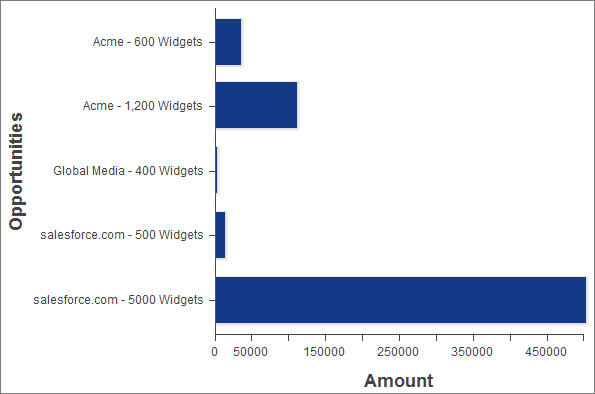
There are two important things to notice about this example:
- The Visualforce chart components access the data attributes from a List of Opportunity sObjects the same way as from the simple Data object used in A Simple Charting Example.
- The object field names used as data attributes are case-sensitive in JavaScript while field names in Apex and Visualforce are case-insensitive. Be careful to use the precise field name in the
fields, xField, and yField attributes of axes and data series components, or your chart will silently fail.
See Also


 j
j