


ISVforce Guide
 j
jNewer Version Available
Trialforce
A Trialforce setup consists of several parts. It’s important to understand these parts and the relationship between them before you start using Trialforce.
- Trialforce Management Organization (TMO)
- The TMO is the starting point for setting up Trialforce and the central location for managing Trialforce after it’s set up. You must file a case in the Partner Community to receive your TMO. The two tasks you perform in the TMO are create Trialforce source organizations and define templates for custom branding.
- Trialforce Source Organization (TSO)
- You use the TSO to create a template for the trial orgs received by your customers. You create the TSO from your TMO. The tasks you perform in a TSO are: install your offering, along with any sample data; specify branding by choosing from the templates you created previously in the TMO; configure the TSO to be exactly as you want your customers to experience it; and generate a Trialforce template, which becomes the basis for all trial organizations.
- Trialforce Template
- The template is a snapshot or exact copy of your TSO at a specific instance in time. You create it from a TSO after you’ve installed your offering and made configuration changes. The Trialforce template is specified in the HTML page from which customers sign up for trials. It defines the trial organization that is provisioned each time a customer signs up.
- HTML Signup Form
- This HTML form serves as the registration page on your website from which customers sign up for trials. You must file a case in the Partner Community to get this form and then customize it with your company details. It is associated with the Trialforce template you plan to use for trials. This ensures that each time a customer signs up for a trial on your website, they receive an organization that is an exact copy of your chosen Trialforce template.
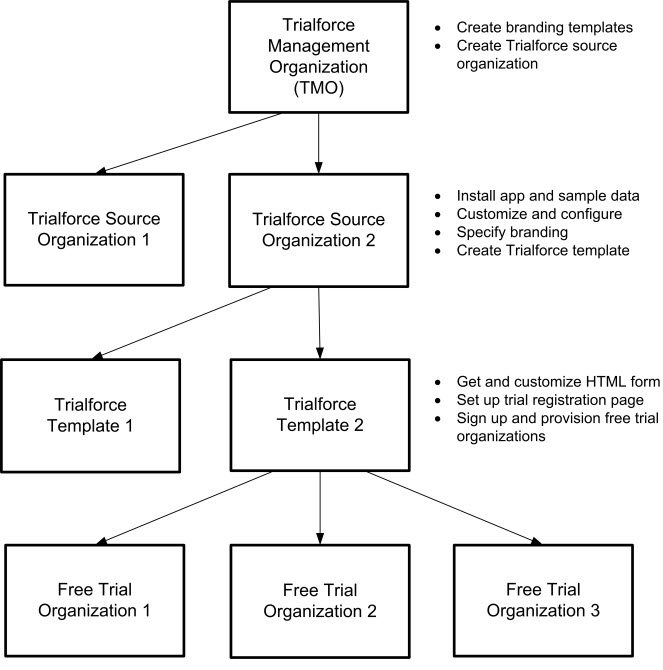
The TMO, TSOs, and Trialforce templates have a hierarchical relationship, as illustrated above.
- You can create multiple TSOs from a given TMO. For example, if you want to offer trials for two different apps, you would generate two different TSOs from the same TMO, one for each app. This enables you to use the TMO as a central hub to manage the trials for all Force.com apps or components produced by your company.
- You can create multiple Trialforce templates from the same TSO. For example, if you release a new version of your component after you’ve started using Trialforce, you can install the upgraded version into the previous TSO and generate a new Trialforce template from it. If you then update your HTML signup form to point to the new Trialforce template, all trial organizations created subsequently have the new version of the package.
As a best practice, we recommend that you have one unique TMO for your company, one TSO for each app or component, and one Trialforce template for each version or edition. Splitting up the configuration process across these different levels makes it easier to maintain and update your trials. Then each time you change something, such as the version, its branding, or a configuration detail of the trial organization, you only need to make the change at one level in the hierarchy. This minimizes the configuration steps involved and makes it easy to concurrently manage trials for multiple products, versions, and editions.
- Using the AppExchange— Customers begin a trial of your offering directly from an AppExchange listing. This approach is ideal if you’re looking for the quickest, easiest way to make a trial available because it requires only a few steps to configure.
- Using an HTML signup form— Customers begin a trial of your offering after filling in a customizable HTML signup form. Because you can modify the form’s look and feel to match your own website, this approach is ideal for integrating the signup process into your company’s web presence.
- Using the API— You provision a trial of your app or component programmatically using the SignupRequest API. This approach is ideal if you’re looking to have full control of the signup process because it allows for advanced customization.