


Visualforce Developer Guide
 j
jNewer Version Available
Style Existing Visualforce Pages with Lightning Experience Stylesheets
To style your Visualforce page to match the Lightning Experience UI when viewed in Lightning Experience or the Salesforce mobile app, set lightningStylesheets="true" in the <apex:page> tag. When the page is viewed in Salesforce Classic, it doesn’t get Lightning Experience styling.
1<apex:page lightningStylesheets="true">If lightningStylesheets="true", the CSS scoping class slds-vf-scope is automatically applied to the Visualforce page’s <body> element. The scoping class is applied so that your content matches the Lightning Experience UI. If you set applyBodyTag or applyHtmlTag to false, you must manually add the scoping class slds-vf-scope.
Here is a standard Visualforce page
without the lightningStylesheets attribute. The page
is styled with the Classic UI.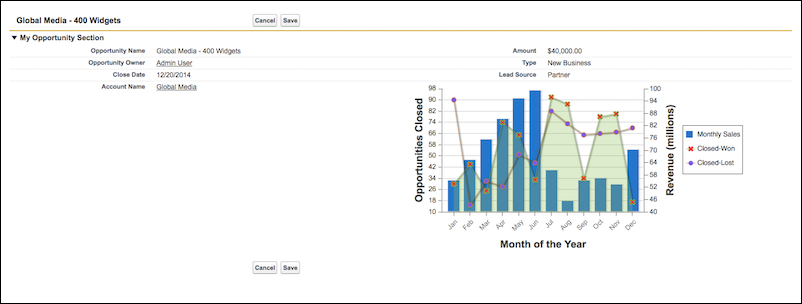
Here is the same Visualforce page with
the lightningStylesheets attribute set to true.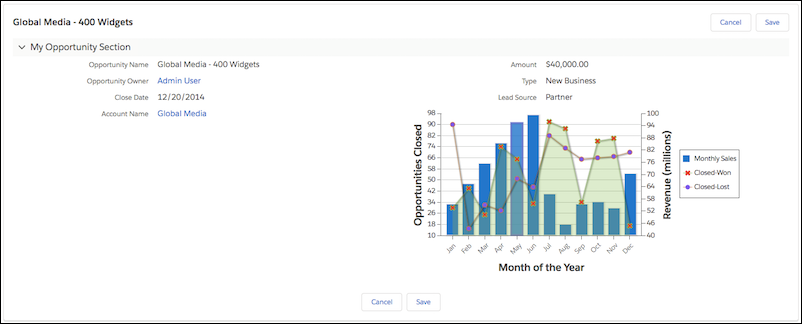
You can style most commonly used Visualforce components with the lightningStylesheets attribute. However, some components differ slightly in style from Lightning Experience. For example, <apex:inputFile>, and some <apex:inputField> elements use the browser’s default styling instead. Commonly used Visualforce components that don’t require styling, such as <apex:form>, <apex:outputText>, and <apex:param>, are still supported.
To include custom SLDS components that aren’t part of the Visualforce component library, use the <apex:slds/> tag with the code and the lightningStylesheets attribute.
When using lightningStylesheets="true", most Visualforce buttons display as the neutral variant. Neutral styling of buttons occurs because there’s no selector hook to reliably determine which buttons must be branded. Add the .slds-vf-button_brand style attribute to the <apex:commandButton> to create a button styled based on your org branding:
1<apex:commandButton styleClass="slds-vf-button_brand" value="Refresh the Page">The following Visualforce components support the lightningStylesheets attribute or don’t require styling.
- analytics:reportChart
- apex:actionFunction
- apex:actionPoller
- apex:actionRegion
- apex:actionStatus
- apex:actionSupport
- apex:areaSeries
- apex:attribute
- apex:axis
- apex:barSeries
- apex:canvasApp
- apex:chart
- apex:chartLabel
- apex:chartTips
- apex:column
- apex:commandButton
- apex:commandLink
- apex:component
- apex:componentBody
- apex:composition
- apex:dataList
- apex:dataTable
- apex:define
- apex:detail
- apex:dynamicComponent
- apex:enhancedList
- apex:facet
- apex:flash
- apex:form
- apex:gaugeSeries
- apex:iframe
- apex:image
- apex:include
- apex:includeLightning
- apex:includeScript
- apex:inlineEditSupport
- apex:input
- apex:inputCheckbox
- apex:inputField
- apex:inputFile
- apex:inputHidden
- apex:inputSecret
- apex:inputText
- apex:inputTextArea
- apex:insert
- apex:legend
- apex:lineSeries
- apex:listViews
- apex:map
- apex:mapMarker
- apex:message
- apex:messages
- apex:outputField
- apex:outputLabel
- apex:outputLink
- apex:outputPanel
- apex:outputText
- apex:page
- apex:pageBlock
- apex:pageBlockButtons
- apex:pageBlockSection
- apex:pageBlockSectionItem
- apex:pageBlockTable
- apex:pageMessage
- apex:pageMessages
- apex:panelBar
- apex:panelBarItem
- apex:panelGrid
- apex:panelGroup
- apex:param
- apex:pieSeries
- apex:radarSeries
- apex:relatedList
- apex:remoteObjectField
- apex:remoteObjectModel
- apex:remoteObjects
- apex:repeat
- apex:scatterSeries
- apex:scontrol
- apex:sectionHeader
- apex:selectCheckboxes
- apex:selectList
- apex:selectOption
- apex:selectOptions
- apex:selectRadio
- apex:stylesheet
- apex:tab
- apex:tabPanel
- apex:toolbar
- apex:toolbarGroup
- apex:variable
- chatter:feed
- chatter:feedWithFollowers
- chatter:follow
- chatter:newsFeed
- flow:interview
- site:googleAnalyticsTracking
- site:previewAsAdmin
- topics:widget