


Salesforce Security Guide
 j
jTransaction Security Policies (Legacy)
| Available in: Salesforce Classic and Lightning Experience |
| Available in: Enterprise, Unlimited, and
Developer Editions Requires Salesforce Shield or Salesforce Event Monitoring add-on subscriptions. |
Policies evaluate activity using events that you specify. For each policy, you define real-time actions, such as notify, block, or force multi-factor authentication.
For example, suppose that you activate the Concurrent Sessions Limiting policy to limit the number of concurrent sessions per user. In addition, you change the policy to notify you via email when the policy is triggered. You also update the policy’s Apex implementation to limit users to three sessions instead of the default five sessions. (That’s easier than it sounds.) Later, someone with three login sessions tries to create a fourth. The policy prevents that and requires the user to end one of the existing sessions before proceeding with the new session. At the same time, you are notified that the policy was triggered.
The Transaction Security architecture uses the Security Policy Engine to analyze events and determine the necessary actions.
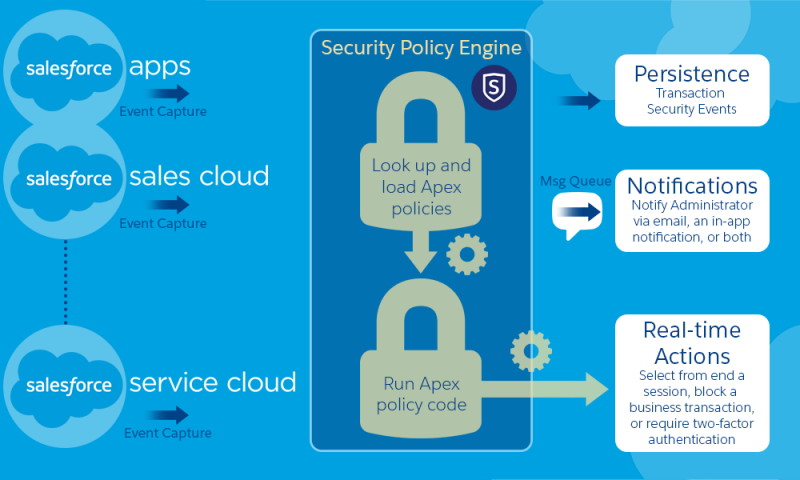
A transaction security policy consists of events, notifications, and actions. For example, when a user tries to export Account data, you can block the operation and get notified by email.