Tableau CRM SAQL Developer Guide
 j
jNewer Version Available
Forecast Future Data Points with timeseries
Use existing data to predict what might happen in the future.
Example - How Many Tourists Will Visit Next Year?
Suppose that you run a chain of retail stores, and the number of tourists in your city affect your sales. Use timeseries to predict how many tourists will come to your city next year:
1q = load "TouristData";
2q = group q by ('Visit_Year', 'Visit_Month');
3q = foreach q generate 'Visit_Year', 'Visit_Month', sum('NumTourist') as 'sum_NumTourist';
4
5-- If your data is missing some dates, use fill() before using timeseries()
6-- Make sure that the dateCols parameter in fill() matches the dateCols parameter in timerseries()
7q = fill q by (dateCols=('Visit_Year','Visit_Month', "Y-M"));
8
9-- Use timeseries() to predict the number of tourists.
10q = timeseries q generate 'sum_NumTourist' as Tourists with (length=12, dateCols=('Visit_Year','Visit_Month', "Y-M"));
11
12q = foreach q generate 'Visit_Year' + "~~~" + 'Visit_Month' as 'Visit_Year~~~Visit_Month', Tourists;
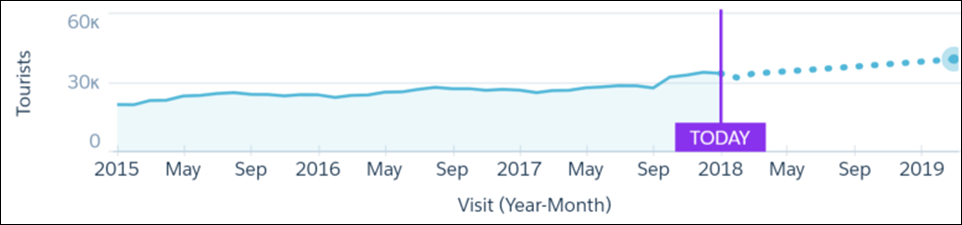
Use a timeline chart and set a predictive line to see the calculated future data. The resulting graph shows the likely number of tourists in the future.