


Service Cloud Voice for Partner Telephony Developer Guide
 j
jNewer Version Available
Queued Callbacks
Call the publishEvent() method with a Call payload having callType of callback and an original inbound call ID as initialCallId to link it with the new callback voice call.
1// Create phone call object
2const call = new PhoneCall({
3            callId: vendorCallKey,
4            phoneNumber : '{CallBack number}',
5            callInfo : { initialCallId: previousVendorCallKey},
6            callType: Constants.CALL_TYPE.CALLBACK.toLowerCase()/*'callback'*/,
7            contact: new Contact({ phoneNumber }),
8            callAttributes: { participantType: Constants.PARTICIPANT_TYPE.INITIAL_CALLER } });
9
10// Publish the event
11publishEvent({ eventType: Constants.EVENT_TYPE.QUEUED_CALL_STARTED, payload: new CallResult({ call })});For example, suppose that a customer makes an inbound call and the connecter creates a VoiceCall VC1. If no agents are available, the IVR asks the customer if they want a callback. If a customer asks for a callback, then the telephony system can queue a callback after an initial delay (in which the callback is initiated as soon as an agent is available) or a callback is scheduled for a customer on a particular date.
A callback can also be requested from a particular agent. The telephony system creates a new voice call VC2 and the connector sends a QUEUED_CALL_STARTED event as per agent availability and routing rules along with callback phone number and VC1 as the initialCallId. The callBack is displayed in Omni-Channel as shown in the following screenshot. When an agent accepts the call, an outbound call is triggered to the given phone number and the previousCall field on the VC2 becomes VC1 and next call on VC1 becomes VC2 in the Voice Call details.
Here are some scenarios where a callback request is accepted but fails to connect with the
customer.
Callback acceptance and outbound call dialing: 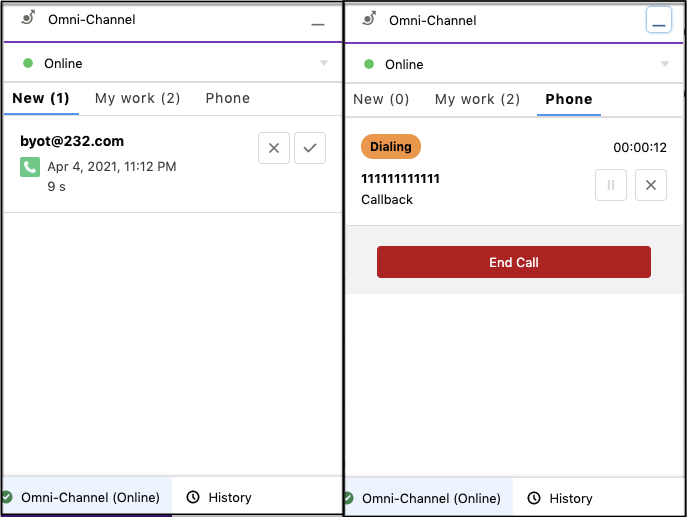
If an agent declines the call or the call times out, the telephony system can try to connect to another available agent with the same VC2.