User Interface API Developer Guide
 j
jNewer Version Available
User Interface API Quick Start
If you don’t already have an org, you can sign up for a Salesforce Developer Edition, also known as a DE org.
This quick start makes a request to the List UI resource, /ui-api/list-info/${objectApiName}. This resource returns a collection of list info summaries for an object.
Before you connect Postman to Salesforce, fork and configure the collection.
These steps use the Postman desktop app to send a request. Alternatively, you can connect the Postman web app to Salesforce using the Trailhead quick start, which requires a CORS configuration in Salesforce.
- Open the Postman desktop app.
- Expand the collection, and select .
- Update the {{_endpoint}} and {{version}} values if needed.
- Go to the Authorization tab to choose your Auth Type and update required information.
- Click Send.
The query returns a 200 OK status. If you receive an error, check your configuration and try again.
The List Info Summary Collection response body includes an array of list info summaries.
1{
2    "count": 6,
3    "currentPageToken": "0",
4    "currentPageUrl": "/services/data/v62.0/ui-api/list-info/Account?pageSize=20&pageToken=0",
5    "lists": [
6        {
7            "apiName": "AllAccounts",
8            "id": "00B58000002ssinEAA",
9            "label": "All Accounts",
10            "url": "/services/data/v62.0/ui-api/list-info/Account/AllAccounts"
11        },
12        {
13            "apiName": "MyAccounts",
14            "id": "00B58000002ssivEAA",
15            "label": "My Accounts",
16            "url": "/services/data/v62.0/ui-api/list-info/Account/MyAccounts"
17        },
18        {
19            "apiName": "NewLastWeek",
20            "id": "00B58000002ssiHEAQ",
21            "label": "New Last Week",
22            "url": "/services/data/v62.0/ui-api/list-info/Account/NewLastWeek"
23        },
24        {
25            "apiName": "NewThisWeek",
26            "id": "00B58000002ssi6EAA",
27            "label": "New This Week",
28            "url": "/services/data/v62.0/ui-api/list-info/Account/NewThisWeek"
29        },
30        {
31            "apiName": "PlatinumandGoldSLACustomers",
32            "id": "00B58000002ssiXEAQ",
33            "label": "Platinum and Gold SLA Customers",
34            "url": "/services/data/v62.0/ui-api/list-info/Account/PlatinumandGoldSLACustomers"
35        },
36        {
37            "apiName": "RecentlyViewedAccounts",
38            "id": "00B58000002ssimEAA",
39            "label": "Recently Viewed Accounts",
40            "url": "/services/data/v62.0/ui-api/list-info/Account/RecentlyViewedAccounts"
41        }
42    ],
43    "nextPageToken": null,
44    "nextPageUrl": null,
45    "objectApiName": "Account",
46    "pageSize": 20,
47    "previousPageToken": null,
48    "previousPageUrl": null,
49    "queryString": null,
50    "recentListsOnly": false
51}
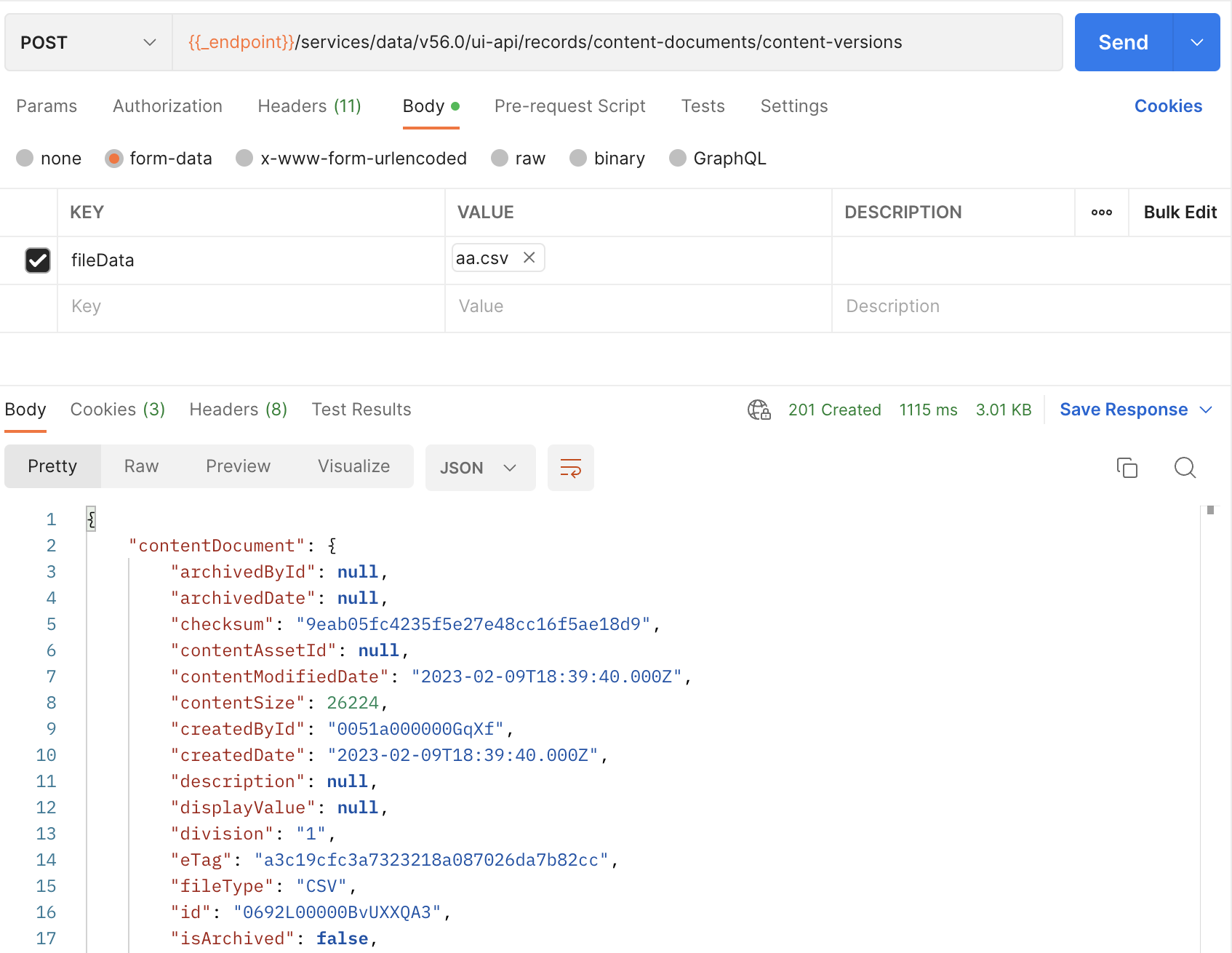
You just sent a UI API request using Postman! You can do more with UI API using Postman, such as sending a cURL command to upload a file to your Salesforce org.
To send a cURL command, import the request using raw text.
- In Postman, click the Import tab on the top left side.
- Select the Raw text tab.
- Paste your cURL command and click Continue.
- Verify your request name and format, then click Import.
- Send your request.
Consider the following guidelines.
- If you’re sending any JSON data as part of your cURL command, the import adds the JSON string as a key on the tab by default. Move the JSON string from the tab to the tab, and delete it from the tab.
- If you’re sending a file using the -F option, upload your file under the tab. For example, you can upload files by adding the fileData key and selecting a local file.