


Salesforce DevOps Center Developer Guide
 j
jUnderstand the DevOps Center Data Model
The DevOps Center object model consists of custom objects that are created when you install the DevOps Center managed package in an org. The top object is Project, which is the direct or indirect parent of almost all other objects. The only exception is Repository, which one or more projects reference.
This diagram shows many of the foundational objects in the DevOps Center object model; not all objects are shown.
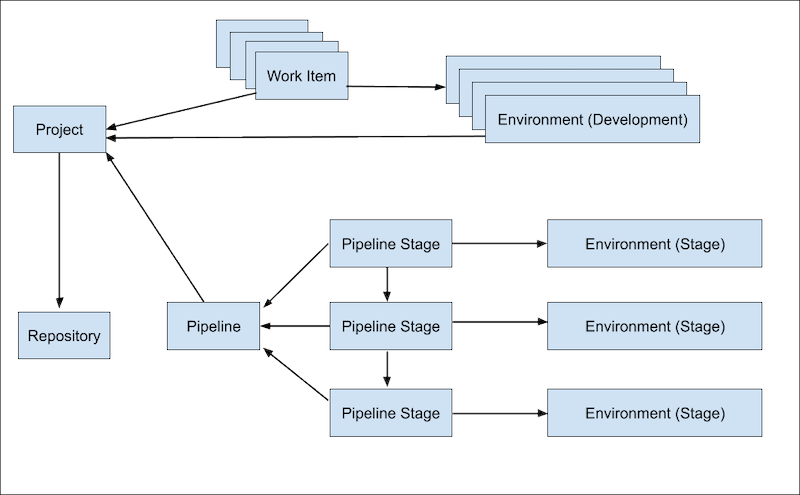
These three objects have direct relationships to the Project object:
- Work Item—Represents a collection of metadata changes. When the user connects the work item to a development environment in DevOps Center (rather than developing and committing externally in the source control repository), the Work Item object references an Environment object. When the work item is promoted, the referenced environment is where the development work was previously done for that item. A single project can have multiple work items.
- Pipeline—Represents the release pipeline. A Pipeline object has one or more Pipeline Stage child objects that represent the stages of the pipeline, such as integration, UAT, and release. The pipeline stages are in a specific order, with the production stage always occurring last. Currently, a project can have only one pipeline.
- Environment—Represents an environment in which development work or testing of the promoted work is done. Projects, work items, and pipeline stages all have direct relationships with environments. Projects have multiple child environments, but work items and pipeline stages each reference only one environment. Currently, the only type of environment is a Salesforce org.
The DevOps Center object model uses validation rules to enforce that all references to work items, environments, pipeline stages, and so on, are contained within a single project. For example, when a work item is promoted to a new pipeline stage, the work item and pipeline stage must both be part of the same project. You can’t connect a work item in one project to an environment that’s connected to a different project.