B2B Commerce Headless API Architecture
Salesforce B2B Commerce Headless enables organizations to build fully customized buyer experiences while leveraging Salesforce Commerce APIs as the backend commerce engine.
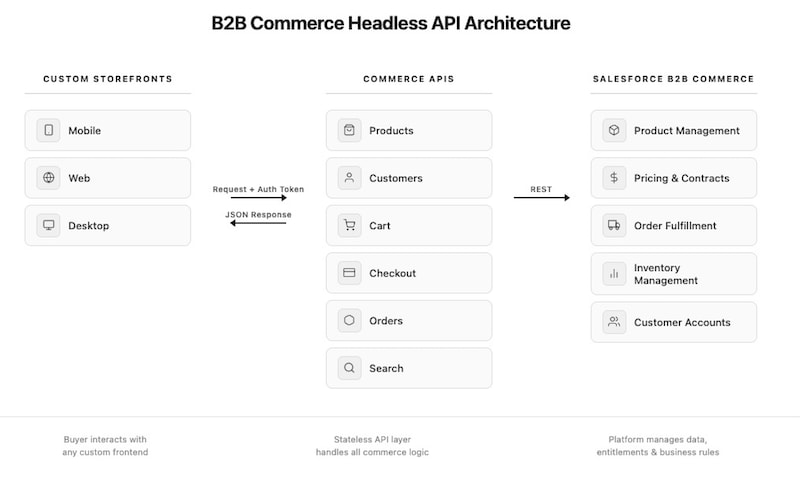
In a headless architecture, the frontend presentation layer is separated from the commerce backend. This allows frontend teams to design and deliver modern digital commerce experiences across multiple channels and platforms.
The Salesforce Commerce Connect REST APIs provide the core commerce capabilities required to power the storefront experience, including:
- Authentication
- Product discovery and search
- Category navigation
- Product detail retrieval
- Cart and checkout orchestration
- Pricing and promotions
- Order placement and order history
- Account and profile management
Benefits of Headless Commerce Architecture
- Frontend Flexibility–Build custom buyer experiences using any frontend framework.
- API-Driven Architecture–Reuse commerce capabilities across web, mobile, and other channels.
- Independent Release Cycles–Frontend and backend teams can iterate independently.
- Omnichannel Enablement–Support multiple customer touchpoints consistently.
- Scalability–Scale frontend applications independently from commerce services.
- Faster Innovation–Rapid experimentation and UI modernization.
- Composable Architecture–Integrate external systems and services more easily.
Architecture Comparison: Headless and Experience Builder
Choose a headless architecture or an Experience Builder storefront based on your business needs, customization needs, and operating model.
Both architectures support Salesforce B2B Commerce capabilities. A headless architecture is useful when your organization requires an independently managed storefront experience or a custom frontend implementation.
| Architectural Dimension | Experience Builder (Standard Site) | Headless Architecture |
|---|
| Speed to market | Uses prebuilt templates and components to accelerate storefront setup and deployment. | Requires custom storefront development and frontend implementation. |
| Design and UI customization | Supports customization within the Experience Builder framework and component model. | Supports full control over storefront design, layout, and user experience. |
| Deployment model | Frontend and backend updates follow Salesforce deployment and release processes. | Frontend applications can be deployed independently from backend commerce services. |
| Operational responsibility | Salesforce manages hosting, scaling, and core platform infrastructure. | Your organization manages frontend hosting, deployment pipelines, and integration layers. |


 j
j