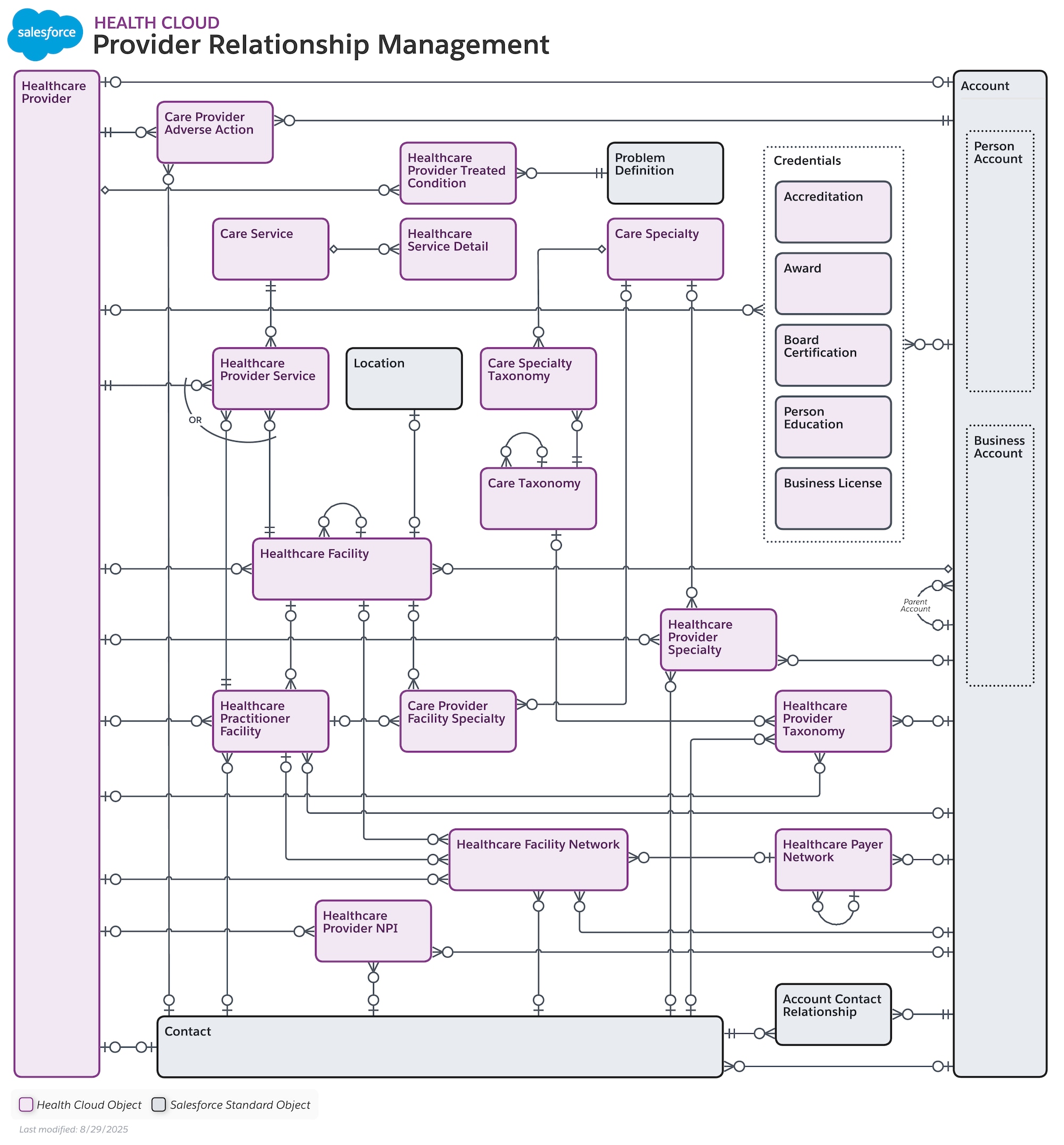
Use the Provider Relationship Management data model along with standard Salesforce objects to manage your provider relationships.
The Provider Relationship Management data model represents the practitioners, facilities, physician relationships, specialties, and organizational hierarchy for your network of providers.
Provider information is also represented using existing standard Salesforce objects in addition to objects only available through Health Cloud and Life Sciences Cloud.
-
Use Composite API Requests to Import Data for Provider Relationship Cards
If you’re setting up provider relationship cards to show practitioner information, you can use Composite API requests to create and link multiple records.
-
Accreditation
Represents the professional accreditations of a facility. For example, a joint commission accredits a facility as a general acute care hospital.
-
Award
Represents a person’s or organization’s professional awards.
-
BoardCertification
Represents the practitioner’s board certifications such as being board-certified in cardiology and cardiovascular disease.
-
BusinessLicense
Represents the licenses of a party role like healthcare provider or producer.
-
CareProviderAdverseAction
Captures adverse actions against the provider, such as malpractice lawsuits or revoked licences. This object is available in API version 47.0 and later.
-
CareProviderFacilitySpecialty
Represents all the specialties that the practitioner provides at a given location. For example, a physician who is board-certified in both spine and neuro may provide spine services at one location and neuro services at another.
-
CareProviderSearchableField
This object holds denormalized data from certain fields in the Provider Relationship Management data model. Provider search APIs query this object instead of multiple objects, which improves search performance. This object is available in API version 47.0 and later.
-
CareProviderSearchConfig
Represents fields that can appear in provider search results. Use this object to specify fields in arbitrary objects (source) that are made available in the search object (target). This object is available in API version 48.0 and later.
-
CareService
Represents a healthcare treatment, service, or procedure offered by a provider, practitioner, or facility. This object is available in API version 59.0 and later.
-
CareSpecialty
Represents a listing of provider specialty codes and descriptions. For example, 02 - Physician/General Surgery.
-
CareSpecialtyTaxonomy
The junction object between CareSpecialty and CareTaxonomy. This object is available in API version 52.0 and later.
-
CareTaxonomy
Represents a static list of taxonomy codes.
-
HealthcareFacilityNetwork
Represents a junction object identifying the insurance network that a location or business entity is a part of. Network participation records are also stored in this object.
-
HealthcarePayerNetwork
Represents an insurance network group. For example, an insurance company’s exclusive provider organization (EPO) plans.
-
HealthcarePractitionerFacility
Represents the different locations in which a practitioner provides services.
-
HealthcareProvider
Represents business-level details about the healthcare organization or the practitioner.
-
HealthcareProviderNpi
Represents identifiers from the National Provider Identifier that are assigned to every facility and licensed practitioner in the United States. Also includes NPI assigned date, primary mailing address on file, and so on.
-
HealthcareProviderService
Represents a junction object between a HealthcareService and a HealthcareProvider or HealthcareFacility or HealthcarePractitionerFacility. This object is available in API version 59.0 and later.
-
HealthcareProviderSpecialty
Represents specialties for a practitioner or a service provider organization. A provider can have multiple specialties such as anesthesiology and cardiovascular.
-
HealthcareProviderTaxonomy
Represents taxonomy or subspecialty codes for a practitioner or facility. A provider or facility can have multiple taxonomies.
-
HealthcareServiceDetail
Represents a junction object between a CareService and a CodeSetBundle. For example, this object links a healthcare service such as physical therapy to a set of related codes. This object is available in API version 59.0 and later.
-
HlthCareProvTreatedCondition
Represents a junction object between a healthcare provider, facility, or practitioner and a problem definition that’s related to a health condition, such as disease or illness. For example, this object links a doctor to the treatment of diabetes, or a facility to the treatment of spinal injuries. This object is available in API version 59.0 and later.
-
PersonEducation
Represents information about professional education for a person in a provider role.
-
PersonEmployment
Represents information about a person’s employment.
-
ProviderSearchSyncLog
Represents a log with information about the provider search data sync status of a healthcare provider record. This object is available in API version 49.0 and later.


 j