


Multitenancy and Metadata Overview
Multitenancy is a means of providing a single application to multiple organizations, such as different companies or departments within a company, from a single hardware-software stack. Instead of providing a complete set of hardware and software resources to each organization, Salesforce inserts a layer of software between the single instance and each organization’s deployment. This layer is invisible to the organizations, which see only their own data and schemas while Salesforce reorganizes the data behind the scenes to perform efficient operations.
Multitenancy requires that applications behave reliably, even when architects are making Salesforce-supported customizations, which include creating custom data objects, changing the interface, and defining business rules. To ensure that tenant-specific customizations do not breach the security of other tenants or affect their performance, Salesforce uses a runtime engine that generates application components from those customizations. By maintaining boundaries between the architecture of the underlying application and that of each tenant, Salesforce protects the integrity of each tenant’s data and operations.
When organizations create custom objects, the platform tracks metadata about the objects and their fields, relationships, and other object definition characteristics. Salesforce stores the application data for all virtual tables in a few large database tables, which are partitioned by tenant and serve as heap storage. The platform’s engine then materializes virtual table data at runtime by considering the corresponding metadata.
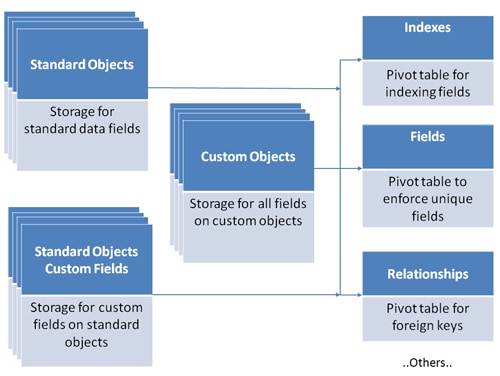
Instead of attempting to manage a vast, ever-changing set of actual database structures for each application and tenant, the platform storage model manages virtual database structures using a set of metadata, data, and pivot tables. Thus, if you apply traditional performance-tuning techniques based on the data and schema of your organization, you might not see the effect you expect on the actual, underlying data structures.
As a customer, you also cannot optimize the SQL underlying many application operations because it is generated by the system, not written by each tenant.
Note
 j
j