Deployment Workflows and Sequence
A typical dev ops cycle involves managing test orgs, sandboxes, and a production org. Your deployment workflow can be a simple deployment of all setup and data from a development org to production. Or, it can be much more complex, involving multiple staging and testing orgs before any changes are sent to production.
Here’s a diagram illustrating several potential deployment plans.
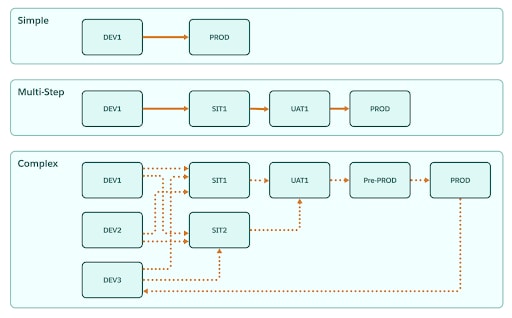
Deployments take two primary forms: full and incremental.
A full deployment involves migrating the entire set of relevant metadata such as objects, fields, classes, triggers, and potentially a significant volume of data from a source org. This ensures that the target org is a complete, synchronized replica of the source at that point in time.
Full deployments are best suited for initial setup, major releases, or when deploying to a completely new, or non-synced environment, such as the first deployment to a sandbox or staging org.
Incremental deployments are used for ongoing DevOps activities. They focus only on the specific metadata components and associated data records that have been created, modified, or deleted since the last successful deployment.
This incremental approach is faster, reduces deployment risk by minimizing the scope of changes, and is essential for maintaining business continuity in a live production environment. Critical to this process is a version control system to track and compare differences between environments, ensuring only the necessary “delta” is packaged and deployed.
Planning for incremental deployments requires change tracking, dependency analysis, and careful sequencing of data and metadata components to ensure that all prerequisites are met in the target environment.
The deployment process must navigate intricate dependencies involving both metadata and the data records themselves. For instance, before deploying the data records for an object, the necessary metadata must be in place first to ensure that the destination org is structurally prepared to receive the data.
Also, there are dependencies based on the record relationships. For example, if you’re deploying a custom object with a lookup to the standard Account object, the Account records must be created first to satisfy the lookup relationship when the custom object’s child records are subsequently inserted. You must also account for parent-child or master-detail relationships, requiring the parent record to be deployed before the child, to preserve referential integrity. Proper assessment and sequencing of these interdependent data and metadata components is vital to avoid validation errors and data corruption.
Sometimes, there are loops in the inter-relationships. For example, an object A depends on object B being deployed earlier, and object B depends on object A being deployed earlier. Let’s say object A goes first, then object B goes next. Because of circular dependencies, one has to redeploy object A a second time to ensure all the references are properly populated.
Here are a few deployment dependency examples.
- The Product Specification Record Type must be deployed before you can insert any Product records.
- The Attribute Based Adjustment Rule must be deployed before you can insert any Attribute Based Adjustment records.
- Decision Tables (metadata records) must be deployed before deploying Pricing Recipes (metadata records).
For complete information on the required deployment sequence, see Object Deployment Sequence and Metadata Deployment Reference.