


Salesforce1 Mobile App Admin Guide
 j
jAccess Data in Salesforce1 While Offline
Caching in Salesforce1 is enabled the first time someone in your org installs one of the Salesforce1 downloadable apps.
The contents of a user’s cache determines the data that’s accessible when the user’s mobile device is offline. Let’s look at how the cache is initially populated and then updated throughout a Salesforce1 session.
- When a user logs in to Salesforce1, the cache is empty. If the user’s device goes offline with an empty cache, no Salesforce data is available.
- Users can quickly populate the cache with a default set of most recently accessed records
in two ways. Users can put Salesforce1 in the background by switching away to a different
app or navigating to the device home screen to populate their cache. Or users can go to the
Salesforce1 navigation menu, select .
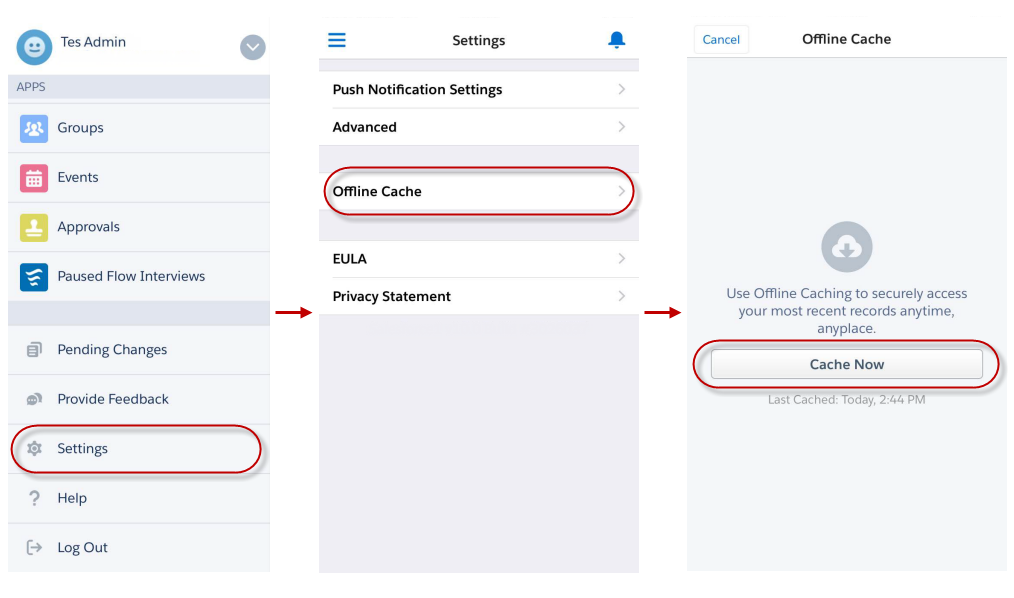
Populating the cache collects recently accessed records for the first five objects listed in the Recent section of the user’s Salesforce1 navigation menu, plus the user’s recent tasks and dashboards. For the first five objects listed in the Recent section of the Salesforce1 navigation menu, up to 30 most recently accessed records are cached per object. For tasks and dashboards, the tasks listed under My Tasks and the five most recently accessed dashboards are cached. Recently accessed records are determined by a user's activities in both Salesforce1 and the full Salesforce site, including Salesforce Classic and Lightning Experience.
After users initially populate their cache, users can refresh their cache in two ways. If the last cache refresh is more than one hour old, users can put Salesforce1 in the background by switching away to a different app or navigating to the device home screen to refresh the cache. Or users can manually refresh the cache by going to the Salesforce1 navigation menu, select .
- Throughout a Salesforce1 session, many of the other records that the user accesses are also added to the cache. (Not all Salesforce data is available offline—see Data and UI Elements That Are Available When Salesforce1 is Offline.)
- A record remains in the user’s cache for 30 days. Each time the same record is accessed, the clock resets. But if the record isn’t touched within 30 days, it’s automatically removed from the cache and won’t be available offline until the user accesses the record again.
- Logging out of Salesforce1 removes all data from the cache. The next time the user logs in, the process of generating the cache starts over.