Agentforce Health Developer Guide
 j
jDiagnosticReport
The diagnosticReport FHIR resource maps to the
DiagnosticSummary object in Salesforce.
FHIR V4.0 - Clinical Data Model Mapping
Here’s how the fields defined by FHIR for diagnosticReport map to the fields in Salesforce.
| Diagnostic Report Resource | Salesforce Field | Type | Salesforce Cardinality | Notes |
|---|---|---|---|---|
| identifier | Identifier | Object | 0.M | The identifier information for a diagnostic summary is represented as Identifier records that reference the DiagnosticSummary record using their Identifier.ParentRecordId field. |
| basedOn | DiagnosticSummary.BasedOnId | Polymorphic Lookup: MedicationStatement, ClinicalServiceRequest | 0.1 |
While FHIR defines diagnosticReport.basedOn as a zero-to-many reference, the Salesforce implementation is a zero-to-one text field. Only references to medication statement and clinical service request records are supported. |
| status | DiagnosticSummary.Status | Picklist | 1.1 | While FHIR defines diagnosticReport.status as a reference to code set bundle, the Salesforce implementation is a picklist. |
| category | DiagnosticSummary.Category | Multi-Select Picklist | 0.M | While FHIR defines diagnosticReport.category as a reference to code set bundle, the Salesforce implementation is a multi-select picklist. |
| code | DiagnosticSummary.CodeId | Lookup: CodeSetBundle | 1.1 | N/A |
| subject | DiagnosticSummary.PatientId | Master-Detail: Account | 1.1 | The Salesforce implementation of diagnosticReport.subject supports references to only patients. |
| encounter | DiagnosticSummary.ClinicalEncounterId | Lookup: ClinicalEncounter | 0.1 | N/A |
| effective.effectiveDateTime | DiagnosticSummary.EffectiveStartDateTime | DateTime | 0.1 | N/A |
| effective.effectivePeriod | DiagnosticSummary.EffectiveStartDateTime | DateTime | 0.1 | Because Salesforce doesn’t support a native period data type, the diagnosticReport.effective.effectivePeriod field is flattened into a set of start date and end date fields. |
| DiagnosticSummary.EffectiveEndDateTime | DateTime | 0.1 | ||
| issued | DiagnosticSummary.IssuedDateTime | DateTime | 0.1 | Because Salesforce doesn’t support a native instant data type, the diagnosticReport.issued FHIR resource is implemented as a date time field in Salesforce. |
| performer | DiagnosticSummary.IssuedById | Lookup: CarePerformer | 0.1 | While FHIR defines diagnosticReport.performer as a zero-to-many resource, the Salesforce implementation is a zero-to-one reference to CarePerformer. |
| resultsInterpreter | DiagnosticSummary.InterpretedById | Lookup: CarePerformer | 0.1 | While FHIR defines diagnosticReport.resultsInterpreter as a zero-to-many resource, the Salesforce implementation is a zero-to-one reference to CarePerformer. |
| specimen | N/A | N/A | N/A | Not supported |
| result | DiagnosticSummary.CareObservationId | Lookup: CareObservation | 0.1 | While FHIR defines diagnosticReport.result as a zero-to-many resource, the Salesforce implementation is a zero-to-one reference to CareObservation. |
| imagingStudy | N/A | N/A | N/A | Not supported |
| media.comment | DiagnosticSummary.ImageComments1 | String | 0.1 | The zero-to-many diagnosticReport.media resource is flattened to five separate zero-to-one text fields and five separate zero-to-one URL fields in the Salesforce implementation. |
| DiagnosticSummary.ImageComments2 | String | |||
| DiagnosticSummary.ImageComments3 | String | 0.1 | ||
| DiagnosticSummary.ImageComments4 | String | 0.1 | ||
| DiagnosticSummary.ImageComments5 | String | 0.1 | ||
| media.link | DiagnosticSummary.ImageUrl1 | URL | 0.1 | |
| DiagnosticSummary.ImageUrl2 | URL | 0.1 | ||
| DiagnosticSummary.ImageUrl3 | URL | 0.1 | ||
| DiagnosticSummary.ImageUrl4 | URL | 0.1 | ||
| DiagnosticSummary.ImageUrl5 | URL | 0.1 | ||
| conclusion | DiagnosticSummary.Summary | String | 0.1 | N/A |
| conclusionCode | DiagnosticSummary.SummaryCodeId | Lookup: CodeSetBundle | 0.1 | While FHIR defines diagnosticReport.conclusionCode as a zero-to-many resource, the Salesforce implementation is a zero-to-one reference. |
| presentedForm | N/A | N/A | N/A | Not supported |
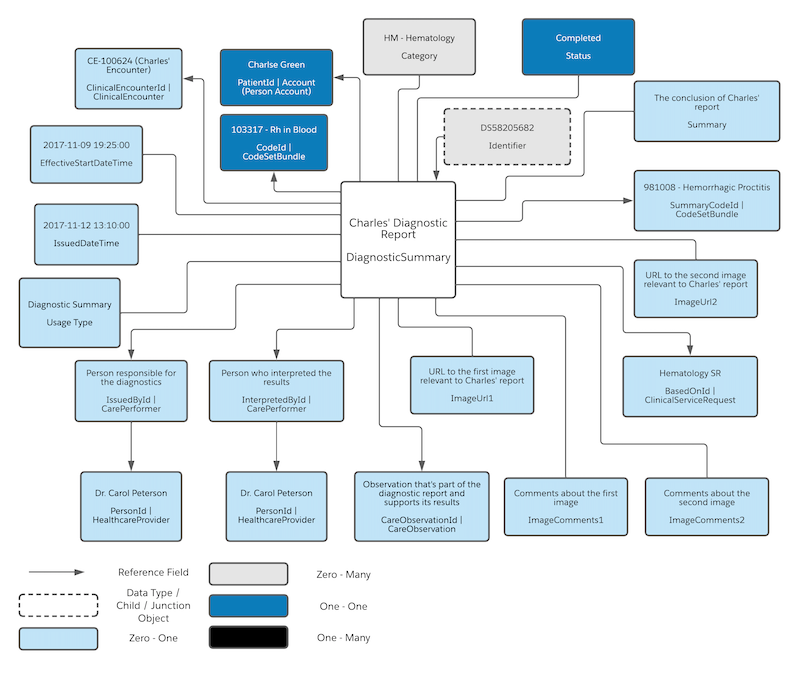
Sample Record Diagram
Here's a diagram that shows an example of how this resource is represented in Salesforce.