


Mobile App Messaging Module
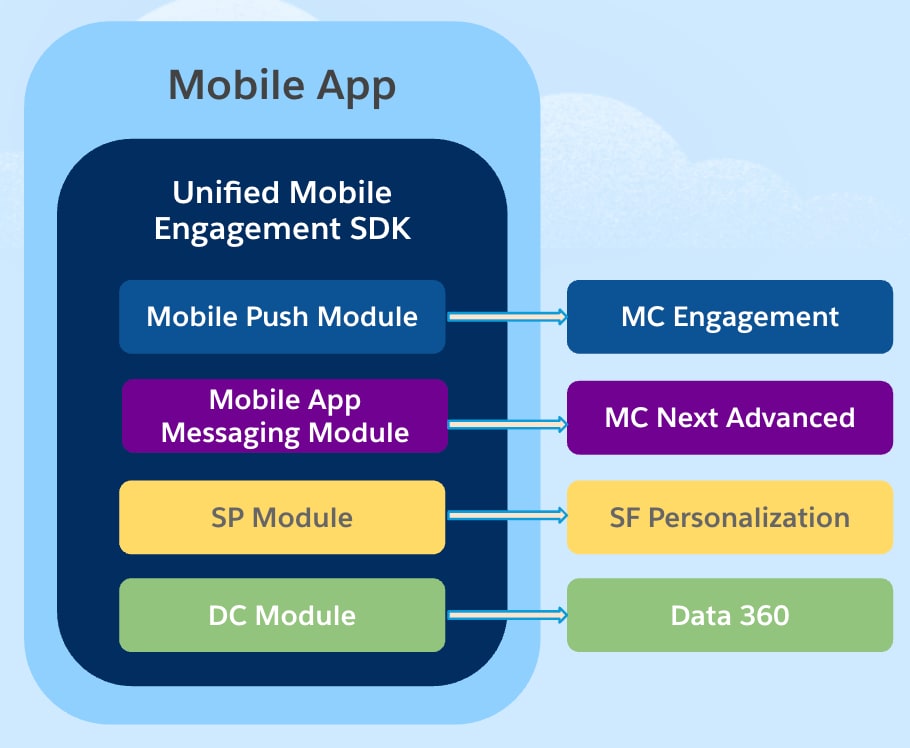
The Mobile App Messaging module is part of the Unified Mobile Engagement SDK, a comprehensive framework that integrates multiple Salesforce cloud services into your mobile application. The Unified SDK provides a modular architecture where each module connects to specific Salesforce cloud platforms - the Mobile App Messaging module connects to Marketing Cloud Next Advanced Edition, enabling sophisticated mobile messaging capabilities.
The Mobile App Messaging module provides developers with a sophisticated toolkit used in apps that run on billions of devices globally across multiple industries. The module facilitates the creation and delivery of personalized mobile app messages.
The Mobile App Messaging module is compatible with Marketing Cloud Advanced Edition. If you use Marketing Cloud Engagement, use the MobilePush module instead. Both modules are part of the Unified SDK.
Note
Minimum Operating System Targets
The SDK works with most Android and iOS releases from the past 10 years. It’s compatible with iOS 12 or later and Android version 6 (API level 23) or later.
Module Size
The Mobile App Messaging module adds minimal size to your app. While the exact size varies slightly from release to release, the Android SDK has a binary size of around 1 MB and the iOS SDK has a size of around 3 MB. The optional iOS extension SDK has a size of around 700 KB.
Battery Use
The Mobile App Messaging module is streamlined for battery efficiency. The module uses less than 1% of the battery on Android and less than or equal to 1% of the battery on iOS.
Built-in Best Practices
We built the Mobile App Messaging module with several mobile messaging best practices in mind.
- The SDK automatically acknowledges device offline mode, queues calls, and retries sending registrations and analytics after reestablishing a connection.
- It uses built-in logarithmic backoff logic to avoid further throttling of device calls to the server during peak load.
- It bundles registrations and handles throttling logic to avoid DDOS situations.
- It includes built-in hashing logic to retry registrations in case Apple or Google change or update the device token.
- It includes automated logic and background controls to handle standard and silent push notifications.
 j
j