Coverage Requirement Discovery
Payer organizations in the healthcare industry can use the FHIR-aligned Coverage Requirement Discovery (CRD) data model to help providers access member and coverage-related information in real time, directly from their Electronic Health Records (EHR) system. The automation of coverage requirement discovery reduces time spent on administrative tasks, improves the chances of coverage approval, and helps in reducing human errors.
| Required Editions |
|---|
| Available in: Enterprise and Unlimited editions of Health Cloud |
When a provider submits a coverage requirement discovery request, you can use the CRD data model to validate the member and their coverage, assess the need for pre-authorization, and check the required documentation.
Coverage Requirement Discovery objects are available to users with the Hls Clinical Decision Support permission set.
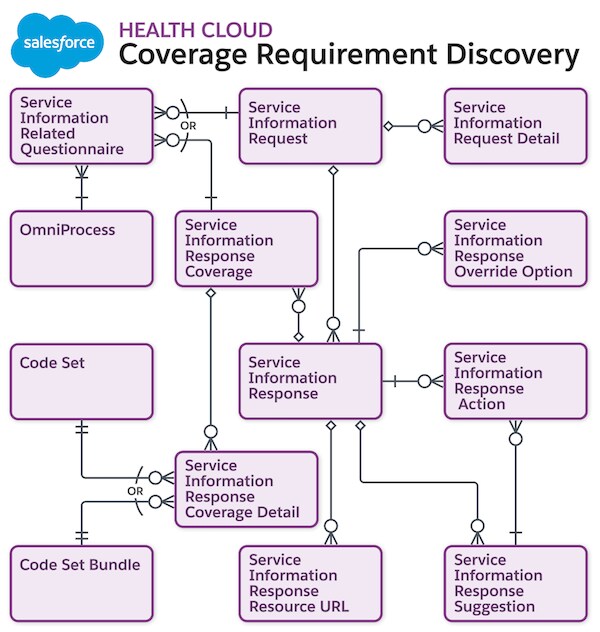
-
ServiceInfoRequestDetail
Represents additional details about a service information request, such as the detail type and detail code. This object is available in API version 63.0 and later.
-
ServiceInformationRequest
Represents information about a service information request, such as the date and time when the request was submitted and the type of service requested. This object is available in API version 63.0 and later.
-
ServiceInformationResponse
Represents a response to a service information request. This object is available in API version 63.0 and later.
-
ServiceInfoResponseAction
Represents actions to be performed as suggested by a service information response. This object is available in API version 63.0 and later.
-
ServiceInfoResponseCoverage
Represents coverage details about a service information response. For example, if additional information or documentation is required for the coverage to be provided. This object is available in API version 63.0 and later.
-
SvcInfoRespCoverageDetail
Represents additional coverage details about a service information response. This object is available in API version 63.0 and later.
-
ServiceInfoRespOvrideOpt
Represents the possible reasons for overriding a service information response. This object is available in API version 63.0 and later.
-
ServiceInfoRespResourceUrl
Represents the URLs of resources relevant to a service information response. This object is available in API version 63.0 and later.
-
ServiceInfoRespSuggestion
Represents suggestions in a service information response. For example, suggesting a change in medication dosage. This object is available in API version 63.0 and later.
-
SvcInfoRelatedQuestionnaire
Represents the questionnaire associated with a service information request or service information response coverage. This object is available in API version 63.0 and later.


 j