


Health Cloud Administration
 j
jRemote Monitoring Patients
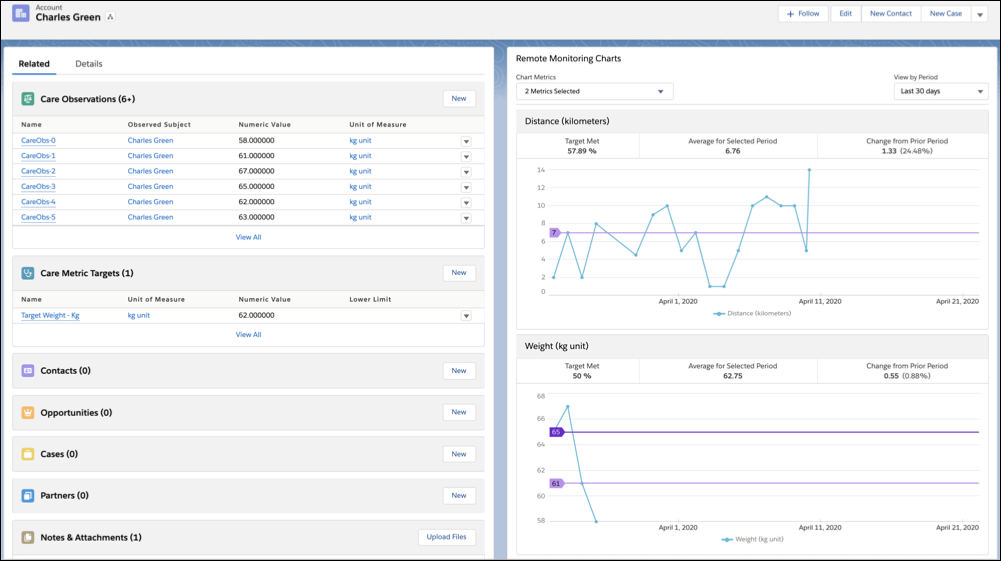
Remote Monitoring allows care coordinators to create a reliable and personalized
connection with patients to motivate them on their healthcare journey. Care Coordinators can
personalize care metric targets for each patient, making it easy to correlate care metrics and
identify healthcare gaps. Charts that show biometric data and health metrics such as heart rate,
blood glucose levels, or weight, help care coordinators track patient health with minimal effort.
When a patient’s biometric data is out of range, care coordinators can proactively engage with
patients.
Remote Monitoring brings multiple benefits to different verticals in the healthcare industry, including:
- For the healthcare consumer: Build trust with providers with more value-based, personalized interactions addressing root causes.
-
For the care coordinator
- Build trust with patients through more personalized, informed, and evidence-based interactions.
- Employ auto-created tasks, care gaps, or cases when patient biometric data is out of range.
- Spend more time giving useful information to patients than collecting data to identify problems.
- Improve operational efficiency with fewer care coordinator calls.
-
For the Provider and Payer business
- Reduce preventable readmissions and emergency department services.
- Shift responsibilities to non-clinical providers to free up clinician time.
- Reduce risk in misdiagnosis or not catching social determinants of health in time.
- Reduce overall spending on chronic disease.
- For the Medical Device business: Enable easier integration with providers and payers.